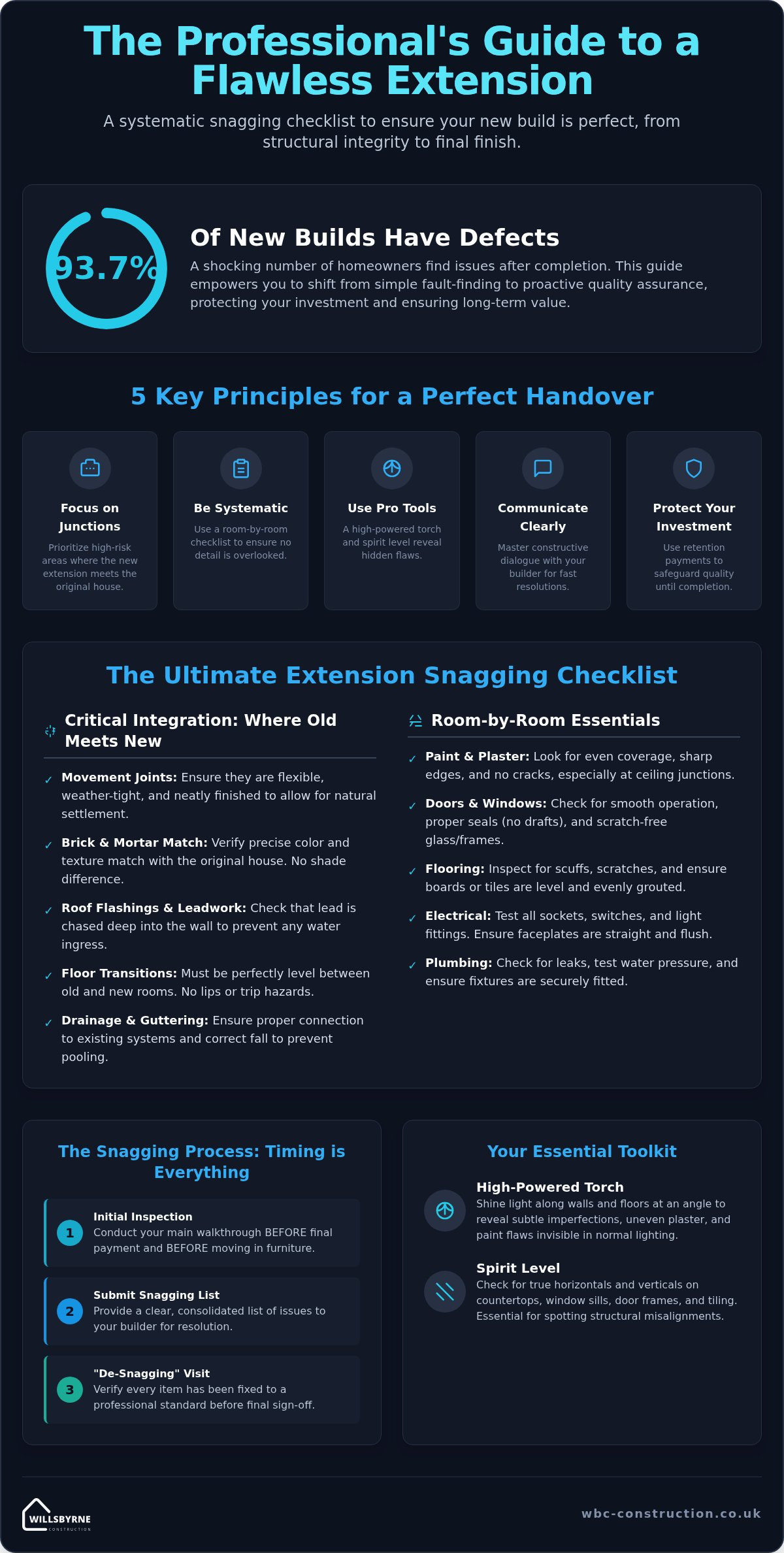
Did you know that 93.7% of homeowners report finding defects in their new construction projects shortly after completion? While the final stages of a build should be a time of celebration, it is often clouded by the fear of missing a hidden structural flaw or the anxiety of confronting a builder about a finish that does not quite meet your expectations. We understand that you want more than just a beautiful room; you want the absolute certainty that every brick and beam has been executed with precision.
This professional-grade snagging list for new extension Princes Risborough projects is designed to strip away that uncertainty. We have distilled years of specialist oversight into a clear, actionable checklist that focuses on the critical junctions where your new structure meets the existing home. By following this methodical approach, you will gain the technical language needed to discuss faults clearly and the peace of mind that your investment is sound. We will guide you through every detail, from subtle aesthetic alignment to the essential integrity of the build, ensuring your project reaches a flawless and frictionless conclusion.
Key Takeaways
- Focus your inspection on the critical junctions where the new structure meets your original home, as these movement joints and roof flashings are high-risk areas for defects.
- Use our professional snagging list for new extension Princes Risborough projects to conduct a systematic, room-by-room walkthrough that ensures no detail is overlooked.
- Equip yourself with a high-powered torch and a spirit level to identify subtle structural misalignments or finishing flaws that are often invisible in standard lighting.
- Master the art of constructive communication with your builder to resolve issues quickly while using contract retention payments to safeguard the quality of the final delivery.
- Shift your perspective from simple fault-finding to a proactive quality assurance process that guarantees the long-term value and structural integrity of your extension.
Understanding Snagging: Why Your Princes Risborough Extension Needs a Professional Eye
A construction project is a complex symphony of materials and labour. Even the most carefully managed build will have minor imperfections that need addressing before the final sign-off. In the industry, we call the process of identifying these final details “snagging”. While some might view What is a snagging list as a simple checklist of paint touch-ups, it’s actually a vital quality assurance phase for your property. It acts as a bridge between the raw construction phase and the polished, lifestyle-ready home you envisioned.
When developing a snagging list for new extension Princes Risborough homeowners, we look far beyond the surface. Extensions often present more challenges than standalone new builds because they must integrate seamlessly with the existing local building stock in Buckinghamshire. The junction where new brickwork meets the original house is a common site for settlement issues or thermal bridging that wouldn’t exist in a standalone property. This integration requires a methodical eye to ensure the two structures are working in harmony.
It’s helpful to distinguish between a “snag” and a “defect”. A snag is typically cosmetic, such as a misaligned socket cover or a scuffed floorboard. A defect is a functional or structural failure, like a draughty window seal or poorly installed drainage. Identifying both early protects your investment and ensures your new space performs as intended for decades. This proactive approach prevents minor issues from evolving into expensive repairs after your builder has left the site.
When is the Right Time to Snag?
Timing is everything. You should ideally conduct your primary inspection before the final payment is released and before you move furniture into the space. Waiting for the standard two-year warranty period is a mistake. It’s much harder to prove a fault was the builder’s responsibility once the room is in daily use. A follow-up “de-snagging” visit is equally important to verify that every item on your list has been resolved to a professional standard.
DIY Snagging vs. Professional Surveys
Many clients feel confident conducting their own walkthrough, especially when paired with a builder-led inspection. However, for complex Buckinghamshire builds involving intricate structural changes, a RICS surveyor can provide an extra layer of technical scrutiny. At WillsByrne, we aim for a zero-snag delivery. Our directors personally manage the transition from active site to final handover, using comprehensive oversight to remove the logistical burden from you while ensuring every detail aligns with our high standards of workmanship.
The ‘Integration’ Check: Spotting Critical Snags Where Old Meets New
The connection between your original home and the new structure is the most technically demanding part of any build. While standard checklists often focus on interior paint, a robust snagging list for new extension Princes Risborough projects must prioritise these external junctions. A poorly executed movement joint can lead to hairline fractures as the new foundation settles at a different rate than the original masonry. We ensure these joints are flexible and weather-tight, maintaining the structural separation required for long-term stability.
Aesthetics matter just as much as integrity. We look for a precise match in brickwork, mortar colour, and rendering texture. If the new mortar is even a shade off, the extension will never truly feel part of the original property. While the New Homes Quality Board provides a framework for quality in new homes, the unique challenges of tying into existing Buckinghamshire heritage require a more nuanced approach. Our team focuses on these details to provide a frictionless experience that respects the character of your home.
Roof flashings and leadwork are equally vital. These components act as the primary barrier against the British weather. We inspect every centimetre of lead where it is chased into the old wall to ensure it’s deep enough to prevent water ingress. Inside, the floor transitions should be perfectly level. A slight lip between the old kitchen and the new dining area is more than a snag; it’s a permanent trip hazard and a sign of poor subfloor preparation.
Structural Junctions and Damp Proofing
We pay close attention to vertical damp proof courses (DPCs) at the tie-in points. Without these, moisture can bridge from the old external leaf into your new internal plaster. You should also check that weep holes are clear of mortar debris. These small gaps allow trapped moisture to escape the cavity, preventing the damp issues that often plague poorly managed extensions. Inspecting the plaster where new walls meet old masonry is also essential, as this is the first place settlement cracks will appear.
Services and Utilities Integration
The integration of modern utilities into an older system is a common source of frustration. Your heating system must be balanced so that new radiators don’t draw all the heat away from the existing rooms. We also verify that your electrical consumer unit has been correctly upgraded and certified to handle the additional load. Finally, ensure that new gutters flow freely into existing soakaways without causing overflow during heavy downpours. Testing these systems under load is the only way to guarantee they’re fit for purpose.
The Ultimate Extension Snagging Checklist: Room-by-Room Essentials
To conduct a thorough final walkthrough, you must move beyond a casual glance. A professional-grade snagging list for new extension Princes Risborough projects requires a systematic, room-by-room approach that leaves nothing to chance. We recommend arriving at the site equipped with a high-powered torch, a spirit level, and your phone to document findings. The torch is particularly vital; it reveals imperfections in plaster and joinery that are often invisible in standard daylight.
When reviewing your project, it’s helpful to adopt a “builder’s eye” regarding acceptable tolerances. Construction involves natural materials and manual labour, so minute variations are expected. However, you should categorise your findings into two clear groups. Urgent snags include functional failures like faulty locks or plumbing leaks. Cosmetic snags cover aesthetic details like paint scuffs or minor sealant gaps. By prioritising these issues, you provide your builder with a clear, logical roadmap for the final sign-off.
Windows, Doors, and Joinery
Test every lock, hinge, and handle multiple times. Modern windows feature “trickle vents” for ventilation; ensure these snap open and shut without resistance. Inspect the perimeter of external frames for a continuous, neat bead of sealant to prevent draughts. Inside, pay close attention to the joinery. Skirting boards and architraves should feature tight mitre joints at every corner. If you see significant gaps where two pieces of timber meet, it often indicates either poor cutting or premature shrinkage that requires a professional fill.
Plastering, Painting, and Decoration
Use the “side-lighting” trick to assess the quality of your wall finishes. By holding your torch parallel to the wall surface, you’ll cast long shadows over any lumps, trowel marks, or uneven patches in the plaster. Check the edges of sockets, switches, and window glass for paint splashes, which suggest a lack of care during the decorating phase. You should also look for “nail pops”—small, circular cracks in the plaster where a screw has slightly moved as the new stud walls settle into place.
Kitchens and Bathrooms
If your extension includes a new kitchen or utility space, run every tap at full pressure to check for leaks in the waste pipes and cabinetry below. Use your spirit level to verify that wall tiles are perfectly aligned and that grout lines are consistent in colour and depth. Appliances must be level to operate efficiently and prevent unnecessary vibration. Finally, check that all cupboard doors are hung straight and close silently, reflecting the high-end emotional style and precision you expect from a bespoke Buckinghamshire build.
Managing the Snagging Process: Communication and Timelines
Once you’ve compiled your snagging list for new extension Princes Risborough builds, the focus shifts to resolution. This stage requires a delicate balance of firm expectations and professional courtesy. Approaching this as a partnership ensures that your builder remains motivated to achieve the high standard of finish you expect. Clear, objective communication is the most effective way to reach a defect-free conclusion without unnecessary tension. We’ve found that a methodical handover process is what separates a stressful project from a truly successful one.
Financial transparency is a cornerstone of a high-end build. Most professional building contracts include a “retention” clause. This typically involves holding back a small percentage of the final payment, often around 2.5% to 5%, until all items on the agreed snagging list are resolved. This isn’t a penalty; it’s a standard industry safeguard that provides peace of mind for the client and a clear roadmap for the contractor. In the Princes Risborough market, a reasonable timescale for resolving minor cosmetic snags is usually seven to fourteen days, though structural adjustments may require more coordination with specialist trades.
It’s vital to remember that Building Control and snagging serve different purposes. A Building Control officer ensures the extension meets safety, structural, and energy standards, but they won’t comment on the quality of your paintwork or the alignment of your skirting boards. You need both a Completion Certificate and a resolved snagging list to truly sign off on the project. If you’re looking for a team that prioritises this level of detail from day one, we invite you to discuss your extension project with WillsByrne.
Effective Communication with Your Contractor
Always present your findings in a single, comprehensive written document. Verbal feedback on a busy site is easily forgotten or misinterpreted. By providing a numbered list accompanied by clear photos, you remove any ambiguity about what needs to be fixed. Photos are particularly helpful for documenting subtle issues like “nail pops” or uneven plastering that might only be visible in specific lighting. This methodical approach demonstrates that you’re serious about quality while remaining professional and organised.
Final Certificates and Legalities
The final sign-off isn’t complete until you’ve collected all relevant legal documentation. Your Building Regulations Completion Certificate is the most critical document for future property sales. Additionally, you must receive Gas Safe and NICEIC certificates for any new heating or electrical installations. Finally, review your structural warranty documents, such as those from the NHBC or similar providers. These papers are the final pieces of the puzzle, confirming that your extension is not only beautiful but also legally compliant and structurally sound.
Beyond the Checklist: How WillsByrne Delivers Excellence
While a comprehensive snagging list for new extension Princes Risborough projects is a vital safety net, our goal at WillsByrne is to ensure you rarely need to use it. We believe that a high-quality build shouldn’t rely on a final rescue mission of repairs. Instead, we aim for a frictionless handover process where excellence is baked into every stage of the construction. By maintaining rigorous standards from the first day on-site, we minimize the typical defects that often plague residential extensions. Our team-based approach ensures that every detail aligns with your specific vision.
Our approach is rooted in active project management. Every Buckinghamshire extension we undertake receives personal oversight from our directors, Wills and Byrne. This isn’t a hands-off operation. It’s a commitment to being on the ground, identifying potential issues before they become permanent fixtures. This level of accountability means that the builder’s eye is applied daily, not just during the final walkthrough. We focus on long-term structural integrity, ensuring that the junction between the old and new sections of your home remains secure for decades.
A Local Partner You Can Trust
Based in Monks Risborough, we are your local extension experts with a deep understanding of the immediate Princes Risborough area. We value the heritage of local building stock and the specific requirements of Buckinghamshire homes. Our relationship with our clients is built on a foundation of transparency and honesty. From the initial quote through to the final delivery, we provide a clear, chronological flow of information. This methodical building process is why so many of our clients recommend us; they appreciate a partner who values their vision as much as the structural perfection of the build.
Start Your Project the Right Way
Many snags identified at the end of a project are actually the result of poor decisions made at the start. High-quality groundworks are essential for preventing the settlement cracks that often appear in poorly managed extensions. By investing in precise excavation and solid foundations, we remove the logistical burdens of future repairs. Our focus on bespoke design ensures that every finish is tailored to your specific goals, reducing the likelihood of aesthetic misalignments. If you’re ready to experience a build where quality is the standard, not an afterthought, we invite you to discuss your Princes Risborough extension with WillsByrne.
Securing Your Vision with Precision
Mastering the final stages of your build requires a shift from active construction to meticulous quality assurance. By focusing on the critical junctions where your new structure meets the old and using a systematic room-by-room approach, you ensure your investment is both beautiful and structurally sound. This snagging list for new extension Princes Risborough homeowners provides the roadmap needed to navigate the final walkthrough with confidence and clarity.
At WillsByrne, we believe that peace of mind comes from comprehensive oversight and a commitment to zero-snag delivery. Our directors, Wills and Byrne, personally manage every project to maintain our high-quality local reputation in Princes Risborough. We provide end-to-end project oversight so you can focus on the lifestyle benefits of your new space rather than the logistical burdens. Plan your extension with a team that values precision—contact WillsByrne today. We look forward to helping you bring your vision to life with the integrity and excellence your home deserves.
Frequently Asked Questions
What is a reasonable number of snags for a new extension?
A high-quality extension typically presents between 10 and 30 minor items during the final walkthrough. While larger new-build developments often see higher defect rates, a bespoke extension is more contained and easier to monitor. You should expect to find small issues like paint touch-ups, minor sealant gaps, or stiff door handles. A professional-led build aims to resolve these through consistent oversight before you even reach the handover stage.
Can I move into my new extension before the snags are fixed?
You can certainly move in, but it’s often more efficient to resolve cosmetic issues while the room is empty. Once furniture is in place, access for tradespeople becomes restricted and the risk of accidental scuffs increases. We recommend completing the primary walkthrough and documenting your snagging list for new extension Princes Risborough projects before moving belongings into the space to ensure clear accountability for any surface damage identified later.
Should I hold back payment until all snags are completed?
Holding back a “retention” payment is standard practice in professional building contracts. This usually amounts to 2.5% or 5% of the total project value. It isn’t an aggressive tactic; it’s a professional safeguard that ensures the final details are completed to the agreed standard. You shouldn’t hold back the entire final payment for minor cosmetic issues. Only the agreed retention amount should be withheld until the work is finished.
What happens if my builder refuses to fix a snag?
If a builder refuses to address a legitimate snag, refer back to your written contract and the agreed specifications. Most reputable contractors in Buckinghamshire value their local reputation and will resolve issues to maintain goodwill. If a stalemate occurs, you may need to use the retention money to hire another tradesperson to complete the work. Formal mediation is a common next step for larger disputes that cannot be settled through direct communication.
Do I need a professional snagging survey for a small extension?
A professional survey isn’t strictly necessary for smaller projects if you have a keen eye for detail. However, if your extension involved complex structural changes or high-end finishes, a professional eye can provide extra security. For many homeowners, the personal management provided by an experienced director-led team removes the need for external surveys. They ensure quality is maintained throughout the build process rather than just at the end.
Is there a time limit for reporting snags to my builder?
You should report snags as soon as they are identified, ideally within the first few weeks of completion. Most contracts include a “defects liability period,” which often lasts six to twelve months. Reporting issues early is essential. It becomes much harder to prove that a fault resulted from the construction rather than daily wear and tear once the extension has been occupied and used by your family for a long period.
What is the difference between a snag and a structural defect?
A snag is typically a minor cosmetic imperfection, such as a paint drip or a slightly misaligned skirting board. A structural defect is a significant failure that affects the building’s integrity or safety, like a leaking roof or foundation issues. While your snagging list for new extension Princes Risborough builds will include both, structural defects require immediate attention and often fall under long-term warranties or building insurance policies.
Does Building Control check for cosmetic snags?
No, Building Control officers only verify that the work complies with national Building Regulations regarding safety, health, and energy efficiency. They won’t inspect the quality of your tiling, the neatness of your plastering, or the finish of your woodwork. Their role is to ensure the structure is legal and safe. This leaves the aesthetic and functional “snags” for you and your builder to resolve together before the final sign-off.