Most homeowners believe that once a construction crew begins work, the legal responsibility for site safety rests entirely with the builders. In reality, the Construction (Design and Management) Regulations 2015 place specific duties on you as the client. When you’re planning a bespoke garden room or a home extension in Buckinghamshire, the complexity of these legal requirements can feel daunting. It’s natural to feel concerned about potential liabilities or the chaos of managing various tradespeople on your property.
We believe your building journey should be defined by excitement rather than administrative burden. This guide will help you understand the essential role of a principle contractor and how this appointment ensures your project is safe, legal, and entirely frictionless. We’ll explore how professional oversight provides the quiet excellence you expect, transforming a complex site into a disciplined environment. You’ll gain a clear understanding of your obligations and the confidence that your home is in expert hands from the first shovel in the ground to the final delivery.
Key Takeaways
- Clarify the essential role of a principle contractor in managing health, safety, and workflow when multiple trades are present on your site.
- Understand your legal obligations under the CDM 2015 regulations to ensure your home renovation or extension remains fully compliant.
- Learn the distinction between pre-construction design oversight and the active management required during the physical build phase.
- Discover how professional coordination removes the stress of managing various tradespeople, creating a frictionless construction experience.
- Gain confidence in how comprehensive oversight protects your property and ensures the highest standards of workmanship throughout the project.
Understanding the Role of a Principal Contractor in 2026
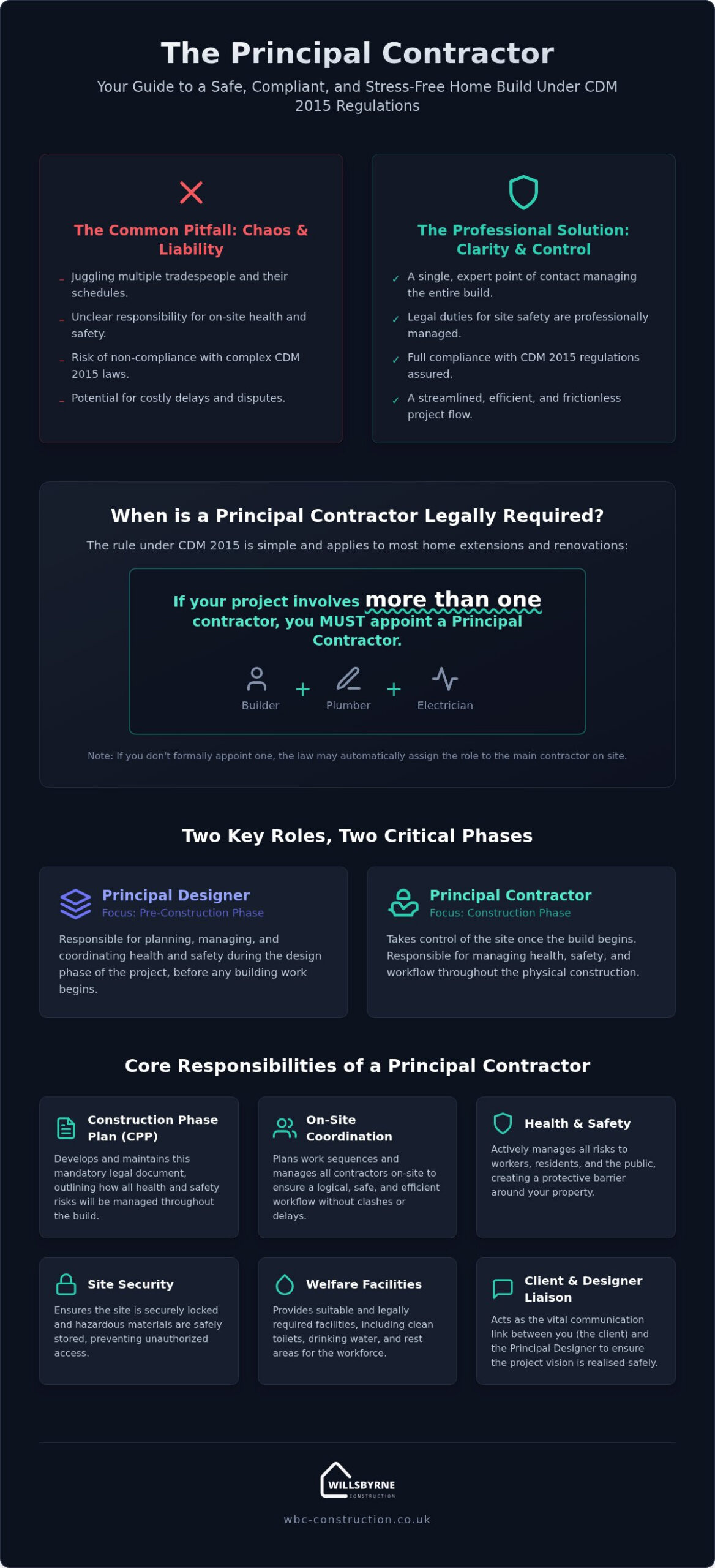
In the context of a sophisticated building project, order is the foundation of success. Under the CDM 2015 regulations, a Principal Contractor is the individual or firm responsible for the entire construction phase. This role was established to harmonize health, safety, and workflow across various specialist teams. When you’re investing in a property renovation or a bespoke garden room, the logistical weight can be heavy. A principle contractor removes this burden. Instead of you personally managing the schedules of five different trades, you have a single point of accountability. This lead partner coordinates every movement on site, ensuring that the plumber doesn’t interfere with the electrician and that the structural work follows a logical, safe progression. For a technical breakdown of how this role functions within the wider industry, you can explore this guide on What is a Principal Contractor? for further context.
When is a Principal Contractor Required?
The rule is simple: if more than one contractor is involved, you must have a Principal Contractor appointed. Many homeowners assume a small extension doesn’t qualify for these regulations. However, as soon as your builder brings in an electrician, a plumber, or a glazier, the legal threshold is met. In the eyes of the Health and Safety Executive (HSE), domestic projects carry significant weight regarding site safety. If you don’t formally appoint a principle contractor, the law typically assigns this responsibility to the lead contractor already on site. This transition ensures that safety standards never lapse, even on smaller residential builds where multiple specialists are required to complete the vision.
Skills and Knowledge Requirements
Managing a residential site requires a unique blend of technical mastery and logistical discipline. A Principal Contractor must have the organizational capacity to plan work sequences weeks in advance. This foresight prevents the chaotic stop-start rhythm that often plagues poorly managed builds. In local areas like Aylesbury, Thame, or Stokenchurch, this also means managing site-specific challenges such as heritage constraints or complex groundworks. Technical expertise is essential, but it must be paired with an uncompromising commitment to site order. This methodical approach is what allows a project to move from initial ideation to final delivery without the typical stresses of construction. By providing comprehensive oversight, the contractor ensures that your home remains a safe working environment and a site of quiet excellence.
Key Responsibilities Under CDM 2015 Regulations
The responsibility of a lead contractor extends far beyond the physical construction of a home extension or garden room. Under the current legislation, the Key Responsibilities Under CDM 2015 demand a rigorous approach to planning and monitoring. This ensures that every phase of the build is conducted with precision. A principle contractor must actively manage the risks to both workers and the public, creating a protective barrier around your property. This oversight is not merely a legal checkbox; it is the mechanism that prevents accidents and ensures a frictionless progression from start to finish. Following the Health and Safety Executive’s May 2026 review, there’s an even sharper focus on the competence of those in charge, making professional selection more critical than ever.
Effective management includes the provision of suitable welfare facilities, such as clean toilets, drinking water, and rest areas. These are legal requirements that maintain the dignity and health of the workforce on your site. Furthermore, site security is a primary duty. In residential neighborhoods like Monks Risborough or Thame, unauthorized access poses a significant risk to curious neighbors or local children. A disciplined lead ensures the site is securely locked and hazardous materials are safely stored at the end of every working day. They also act as the vital link between you, the client, and the Principal Designer, ensuring that the safety intent of the original plans is realized in the physical build.
The Construction Phase Plan (CPP)
Every building project in Buckinghamshire requires a Construction Phase Plan before a single spade hits the soil. This document is a legal prerequisite that outlines how health and safety risks will be managed throughout the build. It isn’t a static piece of paperwork. Instead, it’s a living guide that evolves as the project moves from initial groundworks to the final roof tiling. The CPP sets the site rules and ensures that everyone, from the bricklayers to the decorators, understands the specific hazards of your property. If you’re planning a project, our team manages these details personally to ensure your home extensions and renovations are handled with total professionalism.
Worker Engagement and Site Inductions
The principle contractor holds the duty of ensuring every individual on your property is competent and fully informed. This is achieved through formal site inductions. These sessions cover site-specific risks, such as the location of underground services or overhead power lines. By fostering a culture of consultation, the contractor ensures that workers can report hazards immediately. This disciplined approach maintains a respectful and quiet environment, which is essential when construction takes place within a residential community. It ensures that while your home is a construction site, it remains a safe and orderly part of the neighborhood.
Principal Contractor vs. Principal Designer: What’s the Difference?
The distinction between these two roles is primarily defined by the project timeline. While they share a common goal of site safety, their active phases are distinct. The Principal Designer operates during the pre-construction stage, focusing on the theoretical and structural integrity of the plans. Conversely, the principle contractor takes command once physical work begins, translating those blueprints into a safe and orderly reality. Under the 2026 Building Safety standards, the accountability for each role has been sharpened. This ensures that safety is designed into the project before the first brick is laid. The Health and Safety Executive’s May 2026 review emphasized that these roles must work in harmony to prevent “design-to-site” disconnects. This collaboration ensures that the architectural vision for your home is actually buildable without compromising the safety of the workforce.
For many homeowners, managing two separate entities can introduce unnecessary complexity. Our “design and build” model at WillsByrne simplifies this by providing Professional Oversight across both phases. By acting as the single point of contact, we ensure that the safety vision remains consistent from initial sketches to the final handover. This unified approach removes the logistical friction that often occurs when a designer and a builder operate in isolation. It creates a seamless transition from the planning office to the building site, maintaining the integrity of your vision throughout.
The Principal Designer’s Duties
The Designer’s primary task is to identify and eliminate foreseeable risks during the planning phase. This involves assessing how a design will be built and how it will be maintained in the future. They prepare the “Pre-Construction Information” pack. This critical document provides the principle contractor with the data needed to plan a safe site. Their support is vital during early planning, as they help you navigate your legal duties as a client before any construction begins. They bridge the gap between aesthetic desire and structural safety, ensuring every detail is vetted for compliance.
The Principal Contractor’s Duties
Once the transition to the construction phase occurs, the focus shifts to execution. The contractor’s duty is to implement the safety vision established during the design. This involves constant monitoring of sub-contractor performance to ensure they adhere to the Construction Phase Plan. It is a role defined by active management and discipline. As the project nears completion, the contractor closes the loop by compiling the “Health and Safety File.” This document is a comprehensive record of the build, providing you with essential information for any future maintenance or renovations on your property.
Why Your Buckinghamshire Home Project Needs Professional Oversight
Residential construction in Buckinghamshire carries unique challenges that a principle contractor is specifically equipped to handle. Whether you’re in Thame, Stokenchurch, or Aylesbury, the proximity of neighbors and the constraints of local property boundaries require a disciplined hand. The legal “default” rule under CDM 2015 states that if a domestic client fails to appoint a lead, the contractor in control of the construction phase automatically assumes these duties. This “accidental” appointment can lead to significant confusion if the builder isn’t prepared for the regulatory weight of the role. Expert oversight is particularly vital for home extensions Buckinghamshire, where the complexity of the build often exceeds the capacity of an unmanaged team.
By securing professional leadership, you protect your investment from the volatility of the current market. Construction insolvencies in early 2026 accounted for 17% of all business failures in England and Wales, highlighting the importance of partnering with a stable, methodical entity. A dedicated lead prevents costly delays by coordinating material deliveries and labor schedules with precision. This ensures that your project remains a site of quiet excellence rather than a source of neighborhood tension. This proactive management style transforms a high-stakes undertaking into a predictable, structured progression.
Navigating the Building Safety Act 2026
The landscape of residential construction changed significantly with the 2026 updates to building safety. There are now stricter competency requirements for anyone working on residential projects. This legislation introduced the concept of the “Golden Thread,” a digital record of information that must be maintained from the initial design through to completion. Local Buckinghamshire builders must adapt to these oversight rules to ensure every structural decision is documented and verifiable. This level of transparency builds a bridge of trust between the homeowner and the construction team, ensuring that safety is not just a promise but a documented fact.
Peace of Mind for the Homeowner
The most significant benefit of professional coordination is the removal of the logistical burden from your shoulders. You should never find yourself “acting as the foreman” or chasing sub-contractors for updates. A disciplined approach ensures your project doesn’t become another “cowboy builder” statistic. Instead, you can focus on the evolution of your vision while we handle the complex operational requirements. This methodical management is what defines our service, providing a frictionless experience for every client. If you’re ready to discuss your next project, our team provides comprehensive management for property renovations and garden rooms across the region.
WillsByrne: Your Trusted Principal Contractor in Bucks
At WillsByrne, we operate with a philosophy of total accountability. We believe that a successful build is the result of methodical planning and disciplined execution. This is why we act as the principle contractor by default for every residential project we undertake across Buckinghamshire and South Oxfordshire. By assuming this role from the initial planning stages through to final completion, we provide the comprehensive oversight necessary for a frictionless experience. You won’t find yourself caught between conflicting trades or navigating complex regulations alone. Instead, you’ll have a single, reliable point of contact dedicated to the integrity of your vision and the safety of your home.
Our directors, Wills and Byrne, personally manage every project to ensure our hallmark of quiet excellence is maintained on every site. This hands-on leadership is what sets us apart in areas like Princes Risborough, Chinnor, and Thame. We understand that your property is more than a construction site; it’s your sanctuary. Whether we are installing bespoke garden rooms Aylesbury or managing a multi-stage property renovation, we apply the same rigorous safety framework. This ensures that every specialist on site operates with the precision and respect your home deserves.
Our Methodical Construction Process
Precision is the cornerstone of our operational model. We don’t believe in generic safety plans. Every property has unique constraints, so we develop detailed Construction Phase Plans tailored specifically to your site’s geography and requirements. Our team maintains a network of highly vetted specialist sub-contractors, including electricians and plumbers who share our commitment to high-quality execution. We handle the logistics of their schedules and the verification of their work, so you don’t have to. Transparent communication is a core value here. We keep you informed of every milestone, providing clarity and confidence without the typical stresses associated with managing a building project.
Starting Your Project with Confidence
When you receive a quote from us, it reflects the true cost of a professional, legally compliant build. We include “prelims” and management fees as standard. These aren’t optional extras; they’re the essential resources required for a principle contractor to maintain a safe and orderly site. This honesty ensures there are no surprises as the project progresses. Upon completion, we provide a comprehensive Health and Safety File. This document is a vital asset that protects your property’s future resale value by proving every element of the build meets modern standards. If you’re ready to transform your home with a partner who values heritage and modern management, contact WillsByrne to discuss your upcoming project today.
Building with Confidence and Compliance
Navigating the technicalities of CDM 2015 doesn’t have to be a source of stress. By appointing a dedicated principle contractor, you transform your construction site from a place of potential liability into a disciplined environment of quiet excellence. This oversight ensures that your project remains legally compliant while protecting the long-term value of your property through meticulous documentation and rigorous safety standards. You gain the freedom to focus on the aesthetic evolution of your home, knowing the structural and legal foundations are perfectly secure.
We specialize in high-end residential projects across Buckinghamshire, providing personal management from the initial planning phase through to the final delivery. Every project we undertake includes full CDM 2015 compliance as standard, removing the logistical weight from your shoulders. Our team is committed to delivering a frictionless experience that prioritizes both workmanship and site order. We believe that a successful build is defined by transparency and professional integrity.
If you’re ready to begin your next property renovation or extension, we’re here to provide the expert leadership your home deserves. Let WillsByrne handle the complexities of your next build and experience a truly methodical construction phase. Your vision is a significant undertaking; we’re here to ensure it’s realized with absolute precision and peace of mind.
Frequently Asked Questions
Do I legally need a Principal Contractor for a small house renovation?
Yes, you require a Principal Contractor if your project involves more than one contractor at any time. Most renovations trigger this requirement because they necessitate a mix of specialists, such as a builder, an electrician, and a plumber. The CDM 2015 regulations apply to all construction work in the UK, ensuring that safety is coordinated regardless of the project’s scale.
Can I be my own Principal Contractor if I am managing the build?
While a domestic client can technically assume this role, it is rarely advisable. You must be able to demonstrate the specific skills, knowledge, and experience required to manage site safety effectively. Most homeowners choose to appoint a professional firm to handle these duties, ensuring the project remains fully compliant and safe without the personal legal burden.
What happens if I don’t appoint a Principal Contractor for my extension?
If you don’t make a formal appointment, the lead contractor in charge of the construction phase automatically assumes the role. If you decide to manage multiple separate trades yourself without appointing a lead, you may inadvertently take on significant legal liabilities. This can lead to complications with the Health and Safety Executive if an incident occurs on your property.
Is a Principal Contractor the same as a Site Manager?
No, these are distinct roles even though their daily tasks often overlap. A Site Manager focuses on the practical day-to-day operations and logistics of the build. In contrast, the principle contractor is a statutory role defined by law, carrying specific legal responsibilities for the planning, management, and monitoring of health and safety throughout the entire construction phase.
How much does it cost to hire a Principal Contractor in Buckinghamshire?
Fees for these services are not standardized and vary based on the value, duration, and complexity of your project. Professional contractors usually include these management costs within the “preliminaries” section of their quote. This integrated approach ensures that the necessary oversight and legal compliance are funded as a core part of the construction budget rather than an afterthought.
Does a Principal Contractor need specific insurance?
Yes, they must maintain comprehensive Public Liability and Employers’ Liability insurance to protect the site and the workforce. They should also hold Professional Indemnity insurance that specifically covers their management and coordination duties. You should always verify that your chosen partner has these protections in place before work begins on your Buckinghamshire home.
What is the “Health and Safety File” and why do I need it?
The Health and Safety File is a detailed record of the completed build, containing information essential for future maintenance or renovations. It is a legal requirement under CDM 2015 that your principle contractor prepares this document for you. It serves as a vital asset during property resale, providing future owners with proof that the work was managed professionally and safely.
Can one company be both the Principal Designer and Principal Contractor?
Yes, a single organization can fulfill both roles, which is often the most efficient model for residential projects. This “design and build” approach ensures a seamless transition between the planning and construction phases. It eliminates the risk of communication gaps, ensuring that the safety intent of the original design is perfectly executed during the physical build on site.