What if the most expensive mistake you make on your home isn’t the build itself, but an unrealistic initial budget? We understand that for many homeowners in Oxfordshire, the fear of ‘quote creep’ can turn a dream project into a source of significant stress. You likely already know that the average cost of single storey extension Thame projects has shifted as we move into 2026, influenced by a 12% rise in premium material costs and specific South Oxfordshire District Council (SODC) planning guidelines.
We believe that transparency is the foundation of any successful partnership. We promise to provide you with a meticulous budget framework that accounts for these 2026 trends, ensuring your investment in bespoke craftsmanship delivers both aesthetic beauty and genuine property value without hidden surprises. This guide offers a comprehensive breakdown of current pricing and SODC planning insights, ensuring you’ll have a clear roadmap to achieving a seamless, high-end finish through disciplined project management.
Key Takeaways
- Understand the 2026 average cost of single storey extension Thame projects, accounting for the specific premiums associated with the South Oxfordshire property market.
- Identify how Thame’s unique local factors, including historic site access and River Thame floodplain considerations, can impact your initial foundation and preliminary costs.
- Gain a comprehensive breakdown of professional fees and VAT requirements to ensure your budget remains transparent and free from unexpected financial surprises.
- Explore the most effective extension configurations for Thame’s diverse housing stock, from Victorian side-returns to expansive rear additions for modern semi-detached homes.
- Discover how a meticulous, end-to-end management approach delivers price certainty and peace of mind by prioritising high-end craftsmanship and seamless project delivery.
The 2026 Reality: Average Cost of Single Storey Extension in Thame
Thame’s property market maintains a distinctive resilience. As we move into 2026, homeowners in South Oxfordshire face a specific set of economic factors that push local build costs above the UK national average. The town’s historic charm and its location within the affluent M40 corridor create a high demand for skilled labour. This local competition for trade expertise directly influences the average cost of single storey extension Thame residents should plan for in their initial budgets. It’s a premium environment where quality is non-negotiable.
Proximity to Oxford, just 13 miles away, and London, 47 miles distant, means local contractors often align their rates with city benchmarks. We find that trade professionals in the OX9 postcode are in high demand for high-end refurbishments, which reduces the availability of discount labour. When you invest in a Thame extension, you’re paying for a level of craftsmanship that protects the long-term value of your asset in a high-value postcode.
Thame Price Benchmarks by Project Size
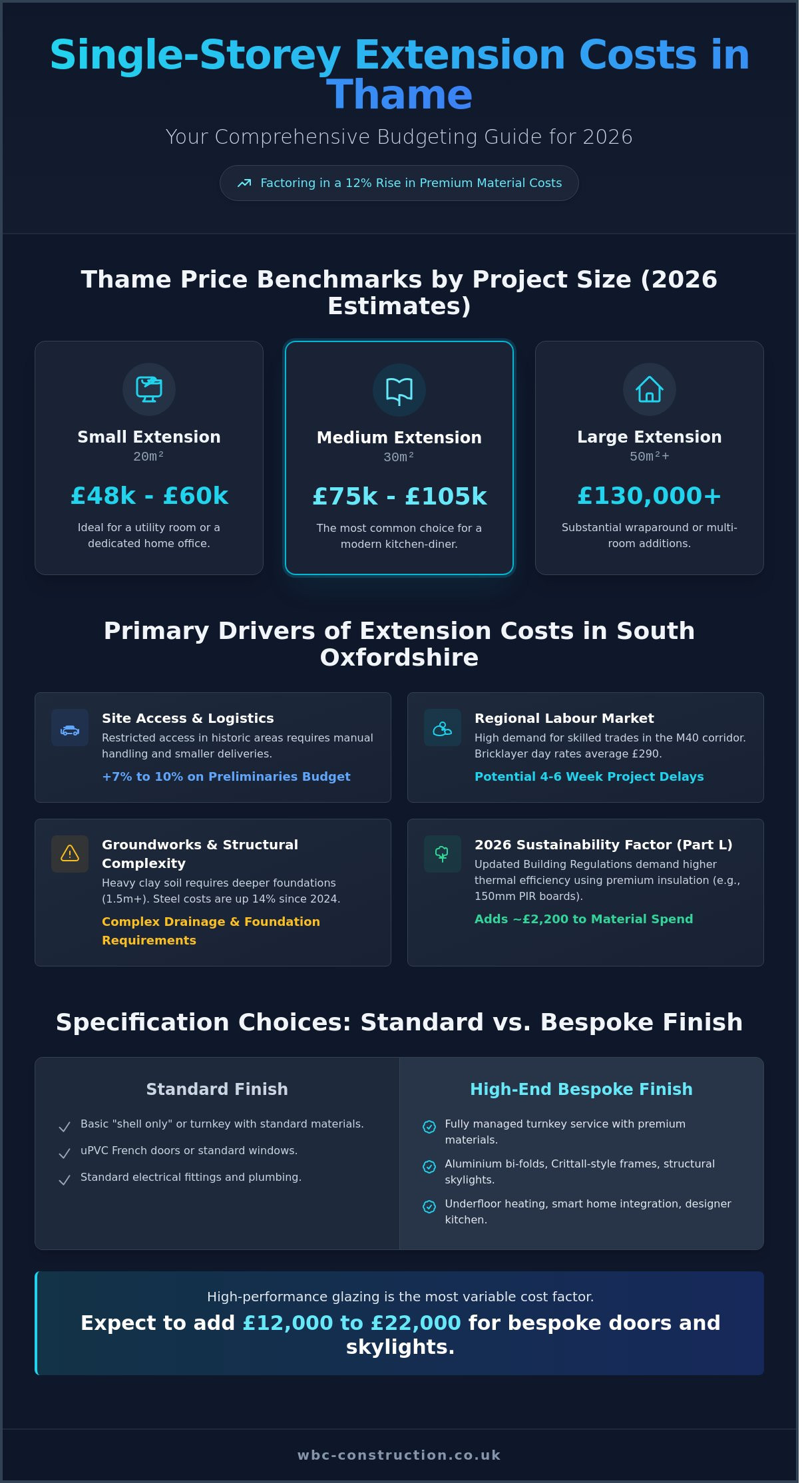
Budgeting for 2026 requires a realistic view of material inflation and local labour availability. These figures represent total project costs including VAT and professional fees:
- Small (20m²) extension: Ideal for a utility room or a dedicated home office. Expect costs between £48,000 and £60,000.
- Medium (30m²) extension: The most common choice for creating a modern kitchen-diner in Thame’s semi-detached homes. Budgets typically range from £75,000 to £105,000.
- Large (50m²+) extension: These substantial wraparound additions or multi-room footprints generally start at £130,000 and can rise significantly based on the internal specification.
Standard vs. Bespoke Finish: What Changes the Price?
The final bill often hinges on the level of delivery and the technical specification of the materials used. A “shell only” project provides the structural envelope but leaves the internal plumbing, electrics, and decorating to the homeowner. Our turnkey approach handles every meticulous detail from the first shovel in the ground to the final coat of paint, providing total peace of mind. The Thame premium represents a 10-15% increase over northern UK averages.
Glazing choices represent the most variable cost factor in 2026. Installing a standard set of uPVC French doors is functional, but many Thame homeowners opt for bespoke aluminium bi-fold doors or “crittall-style” steel frames. High-performance glazing and structural sky lanterns can add £12,000 to £22,000 to the average cost of single storey extension Thame projects, yet they offer the seamless indoor-outdoor transition that defines modern Oxfordshire living.
Primary Drivers of Extension Costs in South Oxfordshire
Calculating the average cost of single storey extension Thame projects involves more than just a price per square metre. Site-specific variables in South Oxfordshire often dictate the final budget. For instance, properties within Thame’s historic conservation areas frequently face restricted access. If your home sits near the High Street or the narrow lanes surrounding the church, limited space might prevent large plant machinery from entering the site. This necessitates smaller, frequent deliveries and manual handling; these logistics typically add 7% to 10% to the total preliminaries budget.
Regional labour market trends also play a significant role. The Bucks and Oxon border is currently a high-demand hub for skilled trades, with bricklayer day rates in 2026 averaging £290. This local demand can extend project timelines by 4 to 6 weeks if a reliable team isn’t secured months in advance. Our team provides a seamless project management service to mitigate these delays and ensure your build stays on schedule.
Structural Complexity and Groundworks
Older Thame properties, particularly those dating from the Victorian era, often require complex drainage realignments. You’ll likely find shared clay pipes that need modernising to meet current standards before any new slab is poured. Additionally, soil composition near the River Thame floodplains or the Chilterns fringe often consists of heavy clay. This requires foundations to reach depths of at least 1.5 metres to prevent seasonal movement. If you’re planning an open-plan layout, structural steel costs for 2026 are projected to be 14% higher than 2024 levels, reflecting global shifts in raw material pricing.
The 2026 Sustainability Factor
The 2026 Building Regulations, specifically the updated Part L, demand higher thermal efficiency than previous years. You’ll need to budget for premium insulation materials, such as 150mm PIR boards or high-performance mineral wool, to achieve mandatory U-values. While these materials increase the initial material spend by roughly £2,200 for a 30-square-metre extension, they significantly reduce long-term energy overheads. Many Thame homeowners now integrate air-source heat pumps during the build phase. While these units cost between £8,500 and £14,000, they offer a sustainable alternative to gas boilers and align with the UK’s 2050 net-zero targets.
Comparing Extension Types: Rear, Side, and Wraparound
Selecting the right footprint is the first step in defining your project’s scope. When calculating the average cost of single storey extension Thame residents can expect in 2026, the specific footprint is the primary variable. We see a high demand for rear extensions in semi-detached homes near the town centre, while detached properties in Lea Park often benefit from more ambitious wraparound designs.
- Rear Extensions: These typically cost between £2,400 and £3,100 per square metre. They’re the most popular choice for creating open-plan living areas that flow directly into the garden.
- Side-Return Extensions: Often seen in Victorian or Edwardian terraces, these utilise the narrow strip of land to the side of the house. Costs range from £2,600 to £3,400 per square metre because of the intricate structural support required to open up the original flank wall.
- Wraparound Extensions: These combine side and rear elements for a total ground-floor reconfiguration. Expect to budget between £2,800 and £3,800 per square metre for this comprehensive approach.
Kitchen Extensions: The Heart of the Thame Home
Kitchens remain the primary driver for extensions. These projects carry higher costs than standard living rooms. Plumbing, gas connections, and heavy-duty electrics for integrated appliances add roughly £15,000 to £30,000 to the base build price. We specialise in creating seamless transitions from these hubs to the garden using flush-threshold bifold doors. Incorporating a bespoke kitchen island or high-end quartz worktops provides a focal point that justifies the investment. It’s about blending utility with effortless style.
Character Matching and Conservation Areas
Properties within the Thame Conservation Area require a meticulous approach to material selection. South Oxfordshire District Council (SODC) often insists on heritage-grade materials to maintain local character. Budgeting for the average cost of single storey extension Thame homeowners face must account for these premium finishes. Matching traditional hand-cut bricks or Chiltern flint can increase your masonry budget by 18% compared to standard alternatives. We manage the sourcing of reclaimed slate and timber-framed glazing to ensure your extension feels like a natural evolution of the original house.
Planning Your Budget: Fees, VAT, and Hidden Costs
When calculating the average cost of single storey extension Thame homeowners often focus solely on the construction price. However, professional fees and statutory compliance represent a significant portion of your 2026 investment. You should allocate between 10% and 15% of your total budget to cover the specialist expertise required before the first spade hits the soil. This foresight ensures the structural integrity and legal standing of your new space.
Architects typically charge 7% to 12% of the total build cost for a full design and oversight service. Structural engineers, vital for ensuring your new open-plan layout is safe, generally require £800 to £1,500 for calculations and drawings. If your property shares a boundary, Party Wall Agreements in Thame currently cost between £1,200 and £2,500 per affected neighbour. These agreements are legal requirements that protect both you and your neighbours during the build process.
Professional Fees and Compliance
Navigating South Oxfordshire District Council (SODC) requirements is a critical step in your journey. In 2026, a standard householder planning application costs approximately £258. Building Control inspection fees, which ensure your extension meets current thermal and structural standards, typically range from £750 to £1,200. We provide a dedicated Project Manager to oversee these moving parts, preventing the costly delays that arise from administrative oversights or failed inspections.
Hidden Costs to Watch Out For
The physical structure is only part of the story. You must account for the 20% VAT reality; always confirm if your quotes include this to avoid a sudden one-fifth increase in your final bill. We recommend a 10% contingency fund as a non-negotiable safety net for 2026 projects. This covers “the unknowns,” such as discovering 19th-century drainage pipes that need rerouting or unexpected ground conditions. Beyond the shell, several factors can impact the average cost of single storey extension Thame residents should prepare for:
- Boiler upgrades: Adding 25 square metres of floor space often requires a higher-capacity boiler to handle the extra radiator load, costing roughly £2,900.
- Garden restoration: Heavy machinery will inevitably damage your lawn and patio; allow at least £3,500 for professional landscaping to make the garden good.
- Internal finishes: High-end flooring, bespoke lighting, and premium decorating can quickly consume £6,000 to £12,000 of your remaining funds.
To ensure your project remains on track from day one, request a transparent, itemised quote from our specialist team.
The WillsByrne Advantage: Meticulous Management in Thame
Achieving a high-end finish without the traditional stress of a building site requires more than just skilled labour; it demands rigorous project management. While the average cost of single storey extension Thame residents encounter can often spiral due to unforeseen delays, we mitigate these risks through our end-to-end service model. By controlling every variable from the initial groundworks to the final coat of paint, we provide the price certainty that modern homeowners require for 2026 financial planning.
Our ‘Master Craftsman’ philosophy dictates that quality workmanship is the most effective way to save money over the lifespan of your home. Cutting corners might reduce the initial quote, but it leads to expensive remedial work within three to five years. We focus on durability and structural integrity, ensuring your investment adds genuine market value to your property. Our commitment includes:
- Fixed-Price Contracts: We provide detailed, transparent contracts that protect you from the market volatility of material costs.
- The Stress Tax Removal: We handle all building regulations, structural engineer liaisons, and site logistics so you don’t have to.
- Accountability: Our team takes full responsibility for the timeline, meaning you’ll never have to chase multiple subcontractors.
A Seamless Experience from Concept to Completion
We’ve spent over 15 years refining our local expertise within Thame, Stokenchurch, and the surrounding Oxfordshire villages. This deep understanding of local architectural styles and planning preferences allows us to navigate the average cost of single storey extension Thame projects with precision. You’ll benefit from a single point of contact who understands your vision and manages the daily complexities of the build. For 2026, we remain committed to delivering every bespoke extension on-time and strictly within the agreed budget.
Start Your Thame Extension Journey
Your project begins with a personal consultation and a comprehensive site survey. Unlike generic estimates, our quoting process involves a meticulous breakdown of costs, giving you a clear roadmap of your 2026 investment before any work commences. We believe that honesty at the pricing stage is the foundation of a successful partnership. We’ll walk you through the technical requirements and aesthetic possibilities, ensuring your new space is both functional and beautiful.
Turning Your 2026 Vision into a Thame Reality
Navigating the 2026 building market requires a blend of foresight and precision. We’ve detailed how the average cost of single storey extension Thame residents face is influenced by South Oxfordshire District Council (SODC) standards and the rising price of premium materials. Success relies on balancing these 2026 projections with a strict 20% VAT allowance and meticulous site management. Our approach removes the stress from this complex process by providing a single point of contact for every phase. We bring bespoke craftsmanship and disciplined project management to every build; this ensures your home’s architectural integrity is preserved. You deserve a seamless transition from initial concept to the final handover. Our team’s deep knowledge of local building regulations provides the peace of mind necessary for such a significant investment.
Request a Professional Site Survey and Extension Quote
Your journey toward a more spacious, refined home begins with a single, expert conversation.
Frequently Asked Questions
How much does a 30m2 extension cost in Thame in 2026?
In 2026, a 30m2 single storey extension in Thame typically costs between £66,000 and £84,000. This range reflects the average cost of single storey extension Thame projects, which currently sit at £2,200 to £2,800 per square metre. Higher-end bespoke finishes or complex structural work can push these figures toward £3,000 per square metre. We provide fixed-price quotes to ensure your budget remains secure throughout the build.
Do I need planning permission for a single storey extension in South Oxfordshire?
You don’t always need planning permission because many extensions fall under Permitted Development rights. Specifically, single storey rear extensions can often extend up to 4 metres for detached houses or 3 metres for others without a full application. However, if your Thame home is a listed building or sits within one of the district’s 72 conservation areas, stricter rules apply. We handle the lawful development certificate process to confirm your project’s compliance.
How long does a typical single storey extension take to build in Thame?
A standard single storey extension usually takes between 10 and 14 weeks to complete from the first ground break. The initial 2 to 3 weeks focus on groundworks and foundations; this is followed by 4 weeks for the shell and roof. Internal fitting, including electrics and plastering, occupies the final month. We use a structured project timeline to manage every trade, ensuring we meet your completion date without unnecessary delays.
Will an extension add more value to my Thame home than it costs to build?
Adding a high-quality extension can increase your property value by 15% to 20% according to recent Nationwide building society data. In the Thame market, where the average house price exceeded £550,000 in 2025, a well-executed 30m2 extension often adds more equity than its construction cost. This return on investment is most significant when the new space creates an open-plan kitchen or an essential home office.
What are the current 2026 building regulations for home extensions?
The 2026 building regulations focus heavily on Part L requirements, which mandate a 31% reduction in carbon emissions compared to previous standards. Every extension must meet strict U-values for insulation in walls, floors, and roofs to ensure thermal efficiency. We manage all inspections with South Oxfordshire District Council inspectors. This ensures your new space meets every safety and environmental standard required for a final completion certificate.
Can WillsByrne help with the planning application and architectural drawings?
We provide a comprehensive design and build service that includes professional architectural drawings and full management of your planning application. Our team coordinates with local Thame surveyors and planning officers to streamline the approval process. By acting as your single point of contact, we eliminate the friction between the design phase and the physical build. This integrated approach ensures the final structure matches the original vision exactly.
What is the difference between a shell-only and a turnkey extension?
A shell-only build covers the structural exterior, including foundations, walls, and the roof, while a turnkey service delivers a finished, ready-to-use room. Turnkey projects represent 85% of our work in Thame because they include all internal plumbing, electrics, and decoration. Choosing a turnkey solution provides a seamless experience where we take full accountability for every detail. You simply move your furniture in once we hand over the keys.
How much should I set aside for a contingency fund?
You should set aside a contingency fund of 10% to 15% of your total project cost. While we provide meticulous fixed-price contracts, this buffer covers unforeseen ground conditions or mid-project design changes you might request. For the average cost of single storey extension Thame residents face, a £7,000 to £10,000 reserve is prudent. Having this financial safety net ensures the build continues smoothly without any budgetary stress.