Your neighbor’s signature is often more valuable than your planning permission when it comes to the ultimate success of your home renovation. While many Buckinghamshire homeowners focus on architectural drawings and planning approvals, the legal framework governing shared boundaries can be the difference between a seamless build and a costly delay. You likely understand the anxiety that comes with potential neighbor disputes or the confusion surrounding what is a party wall agreement and why it’s legally necessary. It’s natural to feel protective of your home and your relationship with those living alongside you.
We believe that clarity is the antidote to project stress. This guide provides everything you need to know about the Party Wall Act 1996 to ensure your home extension remains legally compliant and entirely frictionless. We’ll walk you through your legal obligations, the critical notice periods required by law, and the professional steps required to protect both your property and your peace of mind. By the end, you’ll have a clear roadmap for starting your construction with total confidence while maintaining the goodwill of your adjoining owners.
Key Takeaways
- Understand exactly what is a party wall agreement and how this legal document safeguards your property’s structural integrity during a renovation.
- Identify the specific construction triggers, such as building on boundary lines or inserting support beams, that necessitate a formal agreement.
- Navigate the legal timeline with precision by learning when to serve notices to ensure your project remains compliant and on schedule.
- Explore the role of impartial surveyors in resolving disputes and how an agreed surveyor can streamline the process for both parties.
- Gain peace of mind by understanding how professional oversight ensures all structural work aligns strictly with shared boundary regulations.
Understanding the Party Wall Act 1996 and Your Legal Obligations
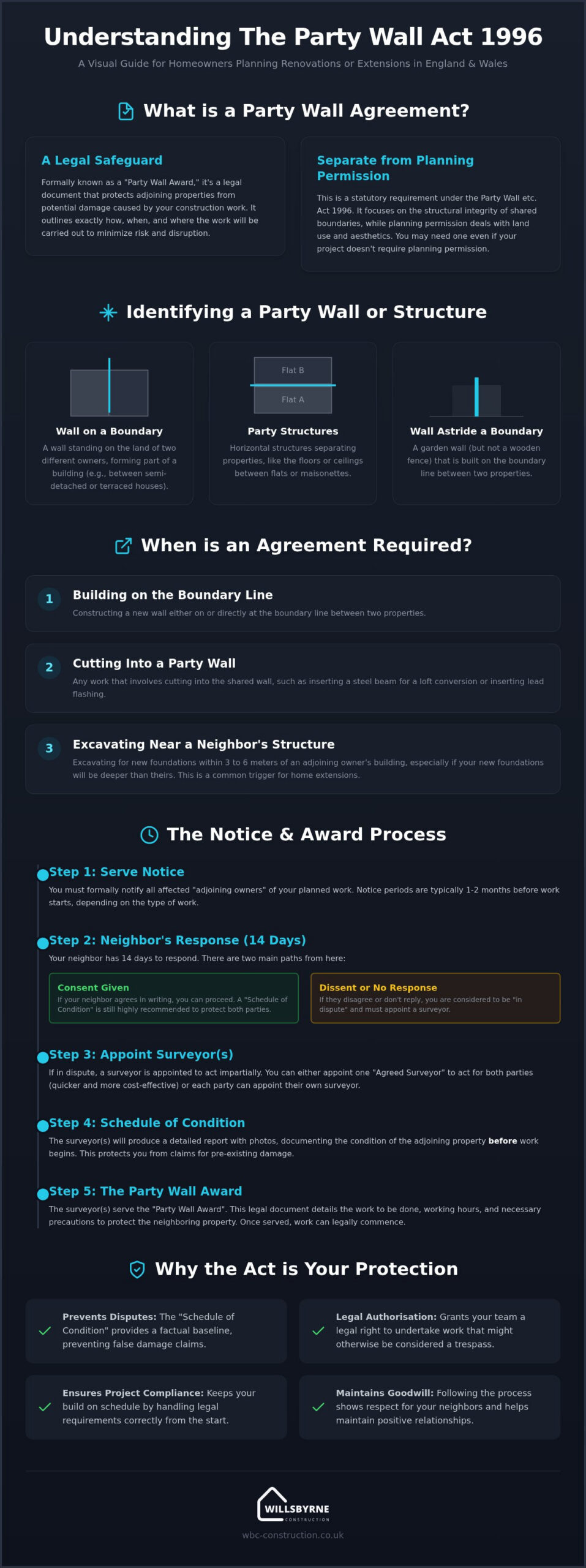
Building work near a shared boundary requires more than just architectural vision; it requires a structured legal framework to protect all parties involved. The Party Wall etc. Act 1996 provides this necessary oversight for homeowners in England and Wales. Essentially, a Party Wall Agreement, often formally referred to as an “Award,” is a legal document that prevents building work from compromising shared structures. It’s a statutory requirement that stands entirely separate from planning permission or building regulations. While planning permission focuses on the use of land and aesthetic impact, this Act focuses on the physical integrity and rights of your neighbors.
If you’re wondering what is a party wall agreement in practical terms, think of it as a set of professional rules for your construction project. It outlines exactly how and when work can be performed to minimize disruption and risk. The Act applies to any “adjoining owner,” which includes anyone whose property or land might be affected by your home extension or property renovation. By following this framework, we ensure that your project proceeds without the burden of legal friction or neighborhood disputes, maintaining the long term value of your home.
What Exactly Counts as a Party Wall?
Identifying whether your project falls under the Act is the first step toward total compliance. A party wall isn’t always as simple as a shared brick wall between two semi-detached houses. The legal definition is broader and includes several specific scenarios:
- Walls that form part of a building and stand on land belonging to different owners.
- Party structures, such as the floors or ceilings that separate flats or maisonettes.
- Garden walls built astride a boundary line, though this excludes standard wooden fences.
Even if you aren’t physically touching the shared wall, excavating within three or six meters of a neighbor’s structure often triggers the need for an agreement. This is why comprehensive oversight during the planning phase is vital to avoid unexpected delays.
Why an Agreement Is Your Best Protection
Many homeowners initially view the Act as bureaucratic red tape, but it actually serves as your most robust structural insurance policy. A primary component of any agreement is the “Schedule of Condition.” This provides a clear, documented record of the adjoining property’s condition before any work starts. This transparency protects you from retrospective compensation claims for “damage” that may have existed long before your builder arrived on site.
Beyond dispute prevention, the agreement legally authorizes your team to carry out necessary structural works that would otherwise be considered a trespass. It shifts the project from a point of potential conflict to a governed, professional undertaking. This methodical approach ensures your home remains a place of peace, built on a foundation of honesty and technical precision.
Common Triggers: When Do You Need a Party Wall Agreement?
Understanding what is a party wall agreement is only half the battle; knowing exactly when one is required ensures your project stays on the right side of the law. In Buckinghamshire, where property styles range from historic cottages to contemporary builds, the triggers for the Act are often found in the fine details of the structural plans. We see these requirements most frequently when homeowners seek to maximize their living space through vertical or horizontal expansion. Failing to identify these triggers early can lead to expensive delays and unnecessary tension with neighbors.
There are four primary physical triggers that necessitate a formal notice under the Act:
- Building a new wall on or directly at the boundary line of two properties.
- Cutting into a shared wall to insert lead flashing or support a new floor beam.
- Demolishing and rebuilding a shared boundary wall that has fallen into disrepair.
- Excavating within three to six meters of a neighbor’s structure for foundations, provided the new foundations are deeper than the existing ones.
Home Extensions and Property Renovations
Most home extensions Buckinghamshire residents undertake will involve some degree of structural tie to a shared boundary. For instance, loft conversions are a common trigger because they often require inserting heavy steel beams into a shared chimney breast to support the new floor. Even internal property renovations can fall under the Act if you plan to thicken or expose shared structural elements. We manage these complexities by identifying these triggers during the initial design phase, allowing for a frictionless transition into the physical construction.
Landscaping and Groundworks Near Boundaries
It isn’t just the main house that requires attention. Significant landscaping and groundworks in sloped gardens across the county often involve deep excavations for new patios or retaining walls. The “Three-Metre Rule” is particularly relevant here. If you are installing bespoke garden rooms Aylesbury, you might need to serve a notice if your foundations are deeper than your neighbor’s and within three meters of their building. Replacing an old brick garden wall that sits exactly on the boundary line also requires compliance with the Act. You can find further details on these specific requirements in the official government guidance. If you aren’t sure if your plans cross these thresholds, our team at WillsByrne Construction & Landscaping can provide the professional oversight needed to clarify your position.
The Notice Process: A Step-by-Step Timeline for Compliance
A successful build in Buckinghamshire relies on a well-structured timeline that respects both legal requirements and neighborly relations. Once you understand what is a party wall agreement, the next phase is executing the formal notice process with precision. We recommend starting this journey as soon as your architectural drawings are finalized to prevent administrative delays from pushing back your groundworks. Following a methodical step-by-step approach ensures that every legal box is checked well before the first spade hits the soil.
- Step 1: Identify Adjoining Owners. We begin by identifying every neighbor whose property or land might be affected. This includes freeholders and any leaseholders with a term of more than one year.
- Step 2: Serve the Formal Notice. You must serve a Party Structure Notice at least two months before starting work on a shared wall. For new walls or excavations, a one-month notice period is required.
- Step 3: Await the Response. Your neighbor has 14 days to respond in writing. They can choose to consent, dissent, or they may simply not respond at all.
- Step 4: Resolution. If a neighbor dissents or fails to respond within the 14-day window, a dispute is deemed to have arisen. At this stage, you must appoint a surveyor to draft the “Award” that allows the project to proceed.
Serving the Notice Correctly
Accuracy is paramount when serving a notice. To be legally valid, the document must include a detailed description of the proposed works, the intended start date, and relevant site drawings. Many homeowners make the mistake of relying on verbal “over the fence” agreements. While friendly conversation is a great starting point, a verbal chat isn’t legally binding under The Party Wall etc. Act 1996. Formalizing the process protects your investment and ensures your search for renovation companies near me leads to a project that stays on its projected schedule.
Responding to Neighbor Concerns
It’s important to remember that a neighbor “dissenting” to a notice isn’t a rejection of your project. In the context of the Act, a dissent simply means the neighbor wants the added protection of a surveyor to oversee the structural implications. We find that maintaining a reassuring partnership with your neighbors through transparent communication often leads to the appointment of an “Agreed Surveyor.” This single professional acts impartially for both parties, which significantly reduces costs and streamlines the path to construction. By leading with honesty and providing clear information early on, you remove the logistical burdens and anxiety often associated with shared boundary work.
Handling Disputes: The Role of Party Wall Surveyors
When a neighbor dissents to a notice, the next step involves appointing a professional surveyor. It’s a common misconception that a surveyor acts as an advocate for the person who hires them. In reality, their statutory duty is to remain impartial and protect the interests of the Act itself. This neutral stance ensures that the construction remains safe and that the rights of both parties are respected throughout the project. Impartiality is the cornerstone of this process, providing a level of professional distance that prevents personal disagreements from stalling your build.
If you and your neighbor are on good terms, you can both agree to use a single “Agreed Surveyor.” This is a highly efficient way to manage the process, as it reduces professional fees while still providing the full legal protection of the Act. The surveyor will produce a “Schedule of Condition,” which is a comprehensive photographic and written report of the neighbor’s property before any work begins. This document is your best defense against future disputes. It clearly identifies any pre-existing cracks or structural issues, ensuring you aren’t held liable for damage you didn’t cause.
Who Pays for the Surveyor?
In almost all standard residential cases, the building owner carrying out the work is responsible for paying the surveyor’s fees. This includes the fees for your neighbor’s surveyor if they choose to appoint their own. While this might seem like an additional burden, it’s a necessary investment in the structural integrity and legal safety of your project. There are rare exceptions where a neighbor might contribute if they are also benefiting from the works, such as the shared repair of a boundary wall or chimney stack. Investing in this process early prevents expensive litigation and ensures a frictionless start to your construction.
What is Included in a Party Wall Award?
The final “Award” is the document that answers the question of what is a party wall agreement in its most tangible, legally binding form. It details the precise terms under which your project can proceed. For homeowners in residential areas like Thame or Stokenchurch, the Award often specifies restricted working hours to minimize noise disruption for families and professionals working from home. It also covers access arrangements, allowing your team to enter the neighbor’s land if structural necessity dictates it. Most importantly, it includes ironclad guarantees regarding the repair of any accidental damage, ensuring that your neighbor’s home is protected. Our team at WillsByrne Construction & Landscaping ensures that every onsite action aligns strictly with these professional standards, protecting your property and your neighborhood relationships.
Frictionless Building: How WillsByrne Manages Structural Integrity
The legal framework of the Party Wall Act only provides value if it is strictly respected during the physical construction phase. We understand that while defining what is a party wall agreement is a vital administrative step, the true measure of success is how that agreement translates to onsite precision. At WillsByrne Construction & Landscaping, we bridge the gap between legal compliance and structural excellence. From the initial groundworks in Princes Risborough to the final structural ties in Chinnor, we ensure your project is a model of quiet excellence and integrity. Our team views the Party Wall Award as a blueprint for neighborhood harmony, not just a document to be filed away.
Our approach centers on comprehensive oversight, ensuring every phase of your home extension or property renovation respects the shared boundaries of your neighbors. We maintain a culture of transparency and honesty, keeping you informed of structural milestones that affect adjoining structures. By treating the legal requirements as a baseline for quality, we remove the logistical burdens from your shoulders and create a build environment defined by order and technical accuracy.
Integrating the Award into the Build Phase
We treat the Schedule of Condition as a live document that guides our onsite team’s daily operations. When performing work near shared walls, we employ cautious, methodical structural methods designed to prevent vibration or settlement issues. This precision protects your neighbor’s property and your long-term reputation within the community. We also prioritize maintaining a clean and orderly site, particularly during high-impact phases like excavations or heavy brickwork. By reducing the physical and auditory impact of construction, we mitigate neighbor friction and uphold the professional atmosphere your home deserves.
Your Single Point of Contact for a Stress-Free Build
Choosing home improvement companies that deeply understand compliance is critical for a successful project. We act as your single point of contact, working alongside your appointed surveyors to ensure every onsite action aligns with the technical specifications of the Party Wall Award. Our team manages the complex intersection of building regulations, structural engineering, and neighborly law so you don’t have to. The WillsByrne promise is simple: we handle the comprehensive oversight and logistical hurdles, leaving you free to focus on the vision and lifestyle benefits of your new space. This methodical progression from ideation to delivery is how we ensure a truly frictionless experience for every Buckinghamshire homeowner.
Securing Your Vision with Structural Integrity
Navigating the legalities of shared boundaries doesn’t have to be a source of project anxiety. By understanding what is a party wall agreement, you transform a potential bureaucratic hurdle into a robust insurance policy for your home. We’ve explored how early notices, impartial surveyors, and a methodical construction approach work together to protect your property and your neighborly relations. Compliance isn’t just about following the law; it’s about building on a foundation of transparency and mutual respect.
At WillsByrne Construction & Landscaping, we specialize in complex residential renovations where structural precision is non-negotiable. Our team provides personal project management from planning to completion, serving homeowners across Thame, Princes Risborough, and the surrounding areas. We handle the comprehensive oversight required to keep your project compliant and entirely stress-free. Discuss your Buckinghamshire extension with our expert team today to ensure your renovation is handled with the quiet excellence it deserves. Your dream home is within reach, and we’re here to ensure the journey is as rewarding as the final delivery.
Frequently Asked Questions
Do I need a party wall agreement for a garden fence?
You typically don’t need an agreement for a standard wooden garden fence. The Act specifically covers party structures and brick or stone walls built astride the boundary line. If you’re replacing a timber fence with a brick wall on the boundary, you must serve a notice. For homeowners in Thame or Chinnor, we ensure your fencing or brickwork projects follow the correct legal path to avoid neighborly friction.
What happens if my neighbor refuses to sign the party wall notice?
If your neighbor refuses to sign or doesn’t respond within 14 days, they’ve technically dissented. This doesn’t stop your project; it simply triggers the appointment of a surveyor to resolve the dispute. We recommend seeking an Agreed Surveyor to act for both parties. This impartial professional creates the Award that allows your home extension to proceed while protecting everyone’s structural interests and maintaining peace of mind.
How much does a party wall agreement cost in Buckinghamshire?
Costs in Buckinghamshire vary based on project complexity and the number of surveyors involved. Industry data from August 2026 suggests an average cost of £1,000 when using a single agreed surveyor. For more complex renovations involving two surveyors, typical fees range from £1,800 to over £5,000. The building owner usually covers these costs, including the fees for the neighbor’s surveyor, to ensure a frictionless start to construction.
Can I start building before the party wall agreement is signed?
You cannot legally begin any work that falls under the Act until the agreement is finalized. Starting early is a trespass and can lead to a court injunction, causing severe delays to your property renovation. We manage your timeline from the planning stage in Princes Risborough to ensure every legal document is signed before our team arrives on site. This methodical approach guarantees your project remains compliant and stress-free.
Does a party wall agreement expire if I don’t start the work?
A Party Wall Award generally remains valid for one year from the date it is served. If you haven’t started the physical works within this 12-month window, the agreement will expire. You’d then need to restart the notice process to remain compliant. We help you synchronize your legal compliance with your build schedule to ensure your structural milestones are met within the valid timeframe and your project proceeds smoothly.
Is a party wall agreement the same as planning permission?
No, they are distinct legal requirements. Planning permission focuses on the aesthetic and social impact of your build on the local area. Conversely, if you’re asking what is a party wall agreement, it’s a specific legal framework focusing on the physical integrity of shared structures. You often need both for a home extension in Stokenchurch to ensure your project is fully authorized, structurally sound, and legally safe.
Do I need an agreement for internal renovations that don’t touch shared walls?
Internal renovations that don’t involve shared walls or deep excavations generally don’t require an agreement. However, if your internal work involves cutting into a shared chimney breast or thickening a party wall, the Act applies. We also check for the Three-Metre Rule regarding foundations for internal structural changes. Our team provides comprehensive oversight to determine exactly when a notice is necessary for your specific renovation project in Buckinghamshire.
Can I draft my own party wall notice or do I need a professional?
You can legally draft your own notice, but it must include specific project details and drawings to be valid. Any error in the documentation can lead to the notice being voided, which restarts your statutory timeline. For complex residential projects in Ibstone, we suggest professional guidance to ensure accuracy. We work alongside specialists to ensure your paperwork is ironclad, removing the logistical burden from your shoulders during the build.