What if the bespoke garage you’ve envisioned becomes a legal liability simply because of a single overlooked boundary measurement? You’ve likely encountered a maze of conflicting advice online, leaving you uncertain about the risks of enforcement notices or non-compliant builds. It’s a common frustration for homeowners who value both quality and integrity. One of the first hurdles in any project is determining: do you need planning permission for a garage in a region as strictly regulated as Buckinghamshire?
We believe that your home improvement journey should be seamless and transparent. This guide provides a clear, professional framework to help you understand exactly when council approval is required, particularly when navigating the 50% land coverage rule that dictates most Permitted Development rights. We’ll detail how to manage the unique restrictions of the Chilterns AONB with total confidence. You’ll learn the essential difference between planning and building control, ensuring your meticulous new build remains a valuable, stress-free asset for your property. Our goal is to provide the professional reassurance you need to move from initial concept to a successful handover.
Key Takeaways
- Understand the nuances of Permitted Development to determine exactly when do you need planning permission for a garage before commencing your project.
- Learn the five essential rules regarding garden area and positioning to ensure your design remains within the legal boundaries of a pre-approved build.
- Identify the specific Buckinghamshire exceptions, such as Article 4 Directions, that may necessitate a formal planning application even for smaller structures.
- Clarify the vital distinction between planning rights and Building Regulations to ensure your garage is both legally compliant and structurally meticulous.
- Explore the benefits of a seamless “concept to completion” model that handles all council liaison and professional coordination for a stress-free experience.
Understanding Permitted Development for Garages in Buckinghamshire
Most homeowners in Aylesbury and Princes Risborough start their project by asking, do you need planning permission for a garage? The answer often lies within Permitted Development (PD) rights. These rights act as a national grant of planning permission for specific types of building work, allowing you to bypass the full application process if your design stays within set limits. For a detached garage, the law usually classifies the project under “Outbuildings.” Understanding Permitted Development is essential because these rights are based on the concept of the “original house.”
The “original house” refers to the property as it stood on 1 July 1948, or as it was first built if it’s newer than that date. Any extensions added by previous owners since 1948 count toward your total allowance. When we consult with clients, we meticulously check the property’s history to ensure the cumulative footprint doesn’t exceed the 50% land coverage limit. This baseline measurement is the foundation of a lawful build.
The Legal Status of Your Garage Project
We distinguish between temporary structures and permanent, bespoke garages. While a flat-pack shed might be considered temporary, a high-end brick or timber garage is a permanent addition to your estate. When clients ask do you need planning permission for a garage, we explain that permanent structures require a more disciplined approach to compliance. We always recommend obtaining a Lawful Development Certificate (LDC) from the council. This document provides written proof that your build was legal at the time of construction. It’s an invaluable asset when you decide to sell your home, as it prevents legal delays during the conveyancing process.
Why Local Context Matters in South Oxfordshire and Bucks
Local councils like Buckinghamshire Council have specific ways of interpreting national policy. While the 2024 planning updates maintain the general framework for outbuildings, local constraints can change the landscape. Properties in South Oxfordshire or the Chilterns often sit within Areas of Outstanding Natural Beauty (AONB) or Conservation Areas. In these protected locations, PD rights are frequently restricted or removed entirely via Article 4 Directions.
Our team handles the logistical burden of checking these local constraints for you. We provide a professional site assessment to give you total peace of mind before a single brick is laid. This proactive approach ensures your vision aligns with the latest 2024 regulations. You don’t want to discover 12 months after completion that your new build violates a local planning directive. By partnering with experts who understand the nuances of the Buckinghamshire landscape, you ensure your investment adds genuine, hassle-free value to your home.
The 5 Essential Rules for Building a Garage Without Planning Permission
Understanding Permitted Development rights is the first step toward a successful project. These rights allow many homeowners to bypass the formal application process, provided the build adheres to strict criteria. When asking do you need planning permission for a garage, the answer usually depends on five core regulations designed to protect the character of the local Buckinghamshire landscape.
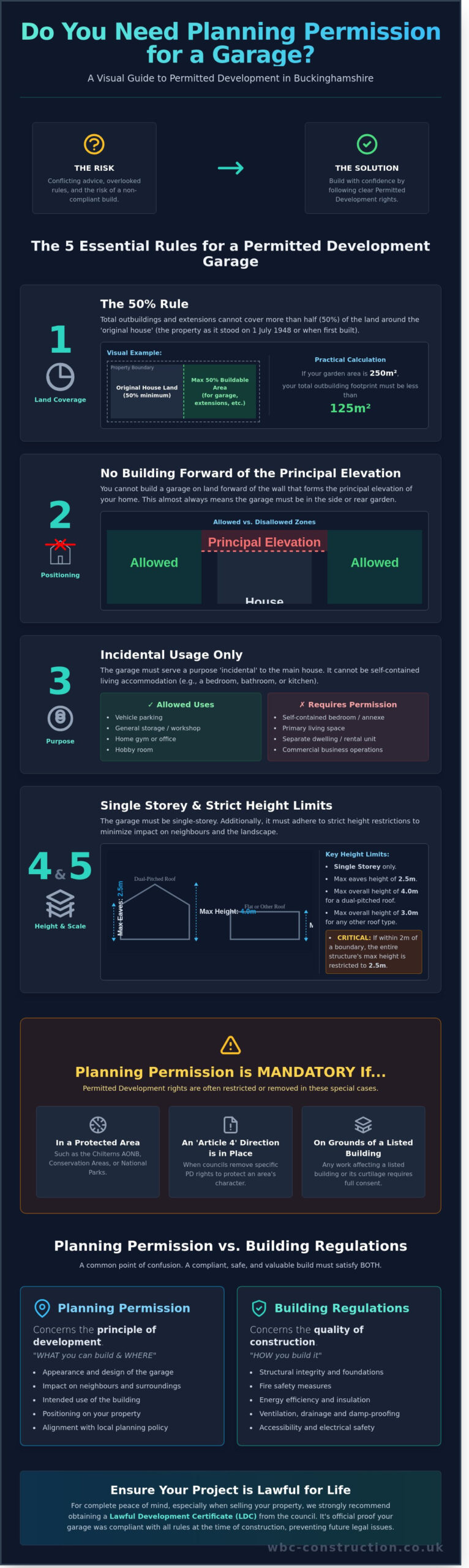
- The 50% Rule: Total outbuildings and extensions cannot cover more than 50% of the land around the original house. If your garden area is 250 square metres, your total outbuilding footprint must stay under 125 square metres to remain compliant.
- Principal Elevation: You cannot construct a garage on land forward of the wall that forms the principal elevation of your home. In most cases, this means the garage must be located to the side or rear of the property.
- Incidental Usage: The building must serve a purpose incidental to the enjoyment of the dwelling. This includes parking, garden storage, or a private gym.
- Single Storey: Permitted Development only covers single-storey structures. Any design featuring a second floor or mezzanine for living space requires a full application.
- Eaves Height: The maximum eaves height must be 2.5 metres. This limit ensures the structure doesn’t overbear on neighbouring properties.
Following official government guidance on outbuildings ensures your project remains lawful from the first day of construction. Our team prioritises these details to provide a reliable path forward for every client. Meticulous planning at this stage provides the foundation for a stress-free experience and long-term value.
Height Restrictions and Roof Types
The geometry of your roof dictates the maximum height allowed. A dual-pitched roof offers the most flexibility, allowing for a peak of 4 metres. This provides significant vertical space for tall shelving or workshop equipment. However, if any part of the garage is situated within 2 metres of your property boundary, the entire structure height is capped at 2.5 metres. This 2.5-metre limit applies regardless of the roof style, including flat or mono-pitched designs, to prevent overshadowing adjacent gardens.
Location and Boundary Considerations
Placement requires precision. A garage must not be built on land within the curtilage of a listed building without specific consent. The “incidental” usage rule is equally vital. You cannot use the space as a self-contained annex or a commercial workshop where clients regularly visit. If you are envisioning a bespoke garage build that includes sleeping quarters, the standard PD rights will not apply. We recommend conducting professional site measurements before any groundworks begin to ensure every centimetre of boundary clearance is accounted for.
When Planning Permission is Mandatory: Local Constraints and Exceptions
A common misconception we encounter is the belief that because a neighbour built a garage without an application, you can do the same. This logic is risky. Planning regulations evolved significantly in 2008 and 2015, meaning a structure built a decade ago may not meet today’s strict criteria. Additionally, Buckinghamshire Council often implements “Article 4 Directions.” These are legal tools that remove your Permitted Development (PD) rights entirely for specific streets or villages to preserve the local character. If your property falls under one of these directions, you must submit a full application regardless of the garage size.
While the official guidance on planning permission for outbuildings provides a general framework, local constraints often override these national rules. A homeowner will always require a full planning application if:
- The garage sits forward of the principal elevation, which is the front of your house.
- The total height exceeds 4 metres for a dual-pitched roof or 2.5 metres if located within 2 metres of your boundary.
- The garage is intended for a commercial business or as a self-contained living space.
Conservation Areas and AONB Restrictions
If your home is in the Ibstone, Stokenchurch, or Chinnor Conservation Areas, the threshold for do you need planning permission for a garage becomes much stricter. Within the Chilterns Area of Outstanding Natural Beauty (AONB), any garage situated more than 20 metres from the main house must not exceed 10 square metres in total area. Local parish councils also demand that materials, such as flint work or specific clay tiles, complement the existing architectural heritage. We ensure every bespoke build respects these aesthetic mandates to secure a seamless approval.
Listed Buildings and Heritage Assets
Living in a listed property removes all Permitted Development rights for outbuildings. You must obtain Listed Building Consent for any structure within the “curtilage” of the property. This term refers to the land immediately surrounding the house, which can sometimes extend further than a standard garden fence. At WBC Construction, we manage the meticulous documentation required for sensitive builds near historic Buckinghamshire landmarks. Our team coordinates directly with conservation officers to ensure the craftsmanship of your new garage preserves the integrity of your heritage asset while providing the modern utility you require. We handle the entire process from concept to completion, removing the logistical burden from your shoulders.
Building Regulations vs. Planning Permission: What Homeowners Forget
Planning permission determines your legal right to change the use of your land or the appearance of your property. Building Regulations exist to ensure the structural safety, energy efficiency, and fire protection of the build itself. While you may have already confirmed whether do you need planning permission for a garage, the technical requirements of Building Control are equally vital for a successful project. We view these regulations as a blueprint for quality rather than a bureaucratic hurdle.
A common misconception is that all small garages are exempt from these rules. In reality, most detached garages with a floor area exceeding 15 square metres require some level of Building Control involvement. If the garage is between 15 and 30 square metres, it only remains exempt if it’s at least one metre from the boundary or built from non-combustible materials. Any structure over 30 square metres requires a full Building Regulations application to satisfy safety standards. Determining if do you need planning permission for a garage is only the first step in a professional build.
In Buckinghamshire, the geological makeup of the ground adds another layer of complexity. Much of the county sits on heavy clay soil, which is prone to significant volume changes during wet and dry seasons. We ensure foundations are engineered to a specific depth to mitigate the risk of subsidence or heave. This meticulous approach to groundworks is what separates a long-lasting asset from a structural liability, providing you with peace of mind that the building is secure for decades.
Attached Garages and Conversions
If your garage is physically connected to your home, it’s legally classified as an extension rather than an outbuilding. This means it must comply with the same stringent insulation and ventilation standards as any other part of your living space. For those considering Home Extensions Buckinghamshire, converting an existing garage requires careful damp-proofing and thermal upgrades to meet current U-values. We handle these details to ensure the space remains comfortable and legally compliant.
Electrics, Plumbing, and Multi-Use Spaces
Modern garages often serve as more than just a place for a car. If you plan to install lighting or power sockets, the work must comply with Part P of the Building Regulations for electrical safety. Adding a sink or a toilet is a common request, but this triggers a requirement for proper drainage and waste disposal plans. If your goal is to create a high-end hobby space or a bespoke garden room, our team manages the entire technical application process. This ensures your new facility is safe, functional, and adds genuine value to your home.
Ready to ensure your project is fully compliant? Contact WBC Construction today for a professional consultation on your garage build.
The WBC Construction Approach: Navigating the Build Seamlessly
We eliminate the logistical burden of home improvements by operating a “concept to completion” model. This means we act as your single point of contact, handling every interaction with local planning authorities and building control officers. You won’t have to spend hours researching “do you need planning permission for a garage” because our team provides the definitive answer based on current UK Building Regulations. We coordinate directly with architects and structural surveyors to ensure every calculation is precise. This integrated approach removes the friction often found when managing multiple independent contractors.
Our team focuses on the fine details that others might overlook. We take pride in our ability to source materials that match your existing property exactly. Whether it’s the specific weathered texture of a Buckinghamshire red brick or the distinct profile of a clay roof tile, we ensure the new structure looks like a natural extension of your home. Our craftsmanship in Monks Risborough and Thame is built on this commitment to aesthetic continuity. We don’t just build garages; we create enduring additions that respect the architectural heritage of the region. Homeowners seeking comprehensive home improvement services in Princes Risborough and Thame will find that this same philosophy of bespoke craftsmanship and transparent project management extends across every aspect of our work.
Professional Site Assessment and Design
Every project begins with a solution-focused site visit. We evaluate your land to determine if the build falls under Permitted Development or requires a full application. This early assessment prevents costly delays and ensures your project remains compliant from day one. We believe in the long-term value of bespoke design. While “flat-pack” kits offer a temporary fix, a custom-built garage can increase your property value by 10% to 15% depending on the finish and functionality.
Bespoke structures allow for seamless integration with your existing landscape. We ensure your new driveway or patio connects perfectly with the garage foundation. This holistic view prevents common drainage issues and creates a unified exterior. Our designs consider everything from internal clearance for modern SUVs to the placement of electrical points for workshop equipment. We build for your lifestyle, not just for the storage of a vehicle.
Starting Your Project in Buckinghamshire
Clarity remains the cornerstone of our service. Our quotes provide a transparent breakdown of materials and labour, ensuring you understand exactly where your investment goes. We don’t believe in hidden fees or vague timelines. We provide a structured programme of works so you know which stage of the build is happening and when. This honesty has made us a trusted partner for homeowners seeking high-end transformations without the typical stresses of construction.
We invite you to book a consultation to discuss your garage or garden project. Our lead project manager will walk you through the possibilities and provide expert guidance on how to maximise your space. We offer a final promise of integrity and quality. Whether we’re pouring a foundation or laying the final ridge tile, our focus remains on delivering a build that exceeds your expectations. Your peace of mind is our primary metric for success.
Securing Your Vision with Expert Garage Construction
Deciding do you need planning permission for a garage depends on your project’s specific dimensions and its location within your property boundary. While Permitted Development covers many standard builds, Buckinghamshire homeowners must remain mindful of local nuances like Area of Outstanding Natural Beauty (AONB) restrictions and specific council mandates. Ensuring your design meets both planning criteria and Building Regulations is the only way to guarantee a seamless, legally compliant addition to your home.
WBC Construction delivers over 5 years of local craftsmanship excellence across the region. We specialise in navigating the complexities of Buckinghamshire Council planning nuances, providing meticulous end-to-end project management that protects your investment. Our team handles every technical detail, allowing you to focus on the transformation of your living space without the typical stress of a major build. We take pride in our transparent approach and our commitment to structural perfection.
Book your bespoke garage consultation with WillsByrne Construction today to discuss your requirements with a partner who values quality and integrity. It’s time to bring your vision to life with complete peace of mind.
Frequently Asked Questions
Can I build a double garage under Permitted Development?
You can build a double garage under Permitted Development if the total area of outbuildings doesn’t exceed 50% of your garden. The structure must be single storey with a maximum eaves height of 2.5 metres. If you choose a dual-pitched roof, the peak can reach 4 metres. We ensure every bespoke double garage project respects these meticulous height limits to maintain your property’s legal standing.
Do I need planning permission to convert my existing garage into a bedroom?
You don’t usually need planning permission to convert an existing garage into a bedroom if the work is internal. This is typically classed as Permitted Development because the building’s footprint doesn’t change. However, you must comply with Building Regulations regarding ventilation and fire safety. If your property is one of the 10,000 listed buildings in Buckinghamshire, you’ll definitely need to secure Listed Building Consent first.
How close to my neighbour’s fence can I build a garage?
You can build a garage right up to your neighbour’s fence, but strict height limits apply. If the structure is within 2 metres of the boundary, the entire building must be no taller than 2.5 metres. This rule protects your neighbour’s access to natural light. We recommend a meticulous survey of the boundary line before starting work to avoid any potential legal disputes regarding land ownership or encroaching foundations.
Is a Lawful Development Certificate really necessary?
An LDC provides formal proof that your garage is lawful, which is vital when selling your home. When asking do you need planning permission for a garage, the answer often depends on having this proof. Solicitors often require this document to confirm the build complied with Permitted Development rules. Obtaining this certificate costs £103 for proposed works and offers complete peace of mind, acting as a definitive legal shield.
What happens if I build a garage without planning permission in Bucks?
If you build without permission, Buckinghamshire Council can issue an enforcement notice requiring you to dismantle the building. This process can be incredibly stressful and costly for homeowners. While you can apply for retrospective permission, there’s no guarantee of approval. Records from the Planning Inspectorate show that thousands of enforcement notices are issued annually across the UK to rectify unauthorised structural works.
Do wooden or timber-framed garages have different planning rules?
Whether you choose a timber frame or traditional masonry, the same planning regulations apply to your build. The General Permitted Development Order 2015 doesn’t distinguish between materials for outbuildings. When asking do you need planning permission for a garage, remember that height and location are the deciding factors. Our team uses premium craftsmanship to ensure your timber garage meets all 2.5-metre height restrictions for boundary builds.
Can I run a business from my new garage without council approval?
You can run a small business from your garage without council approval if the home remains primarily a private residence. If your business activities lead to a marked increase in traffic or noise, the council will require a Change of Use application. For example, a quiet home office is usually fine, but a car repair workshop with 5 daily deliveries would likely trigger the need for formal planning permission.
Does a carport require the same planning permission as a garage?
Carports must follow the same Class E planning rules as fully enclosed garages. They are considered outbuildings and must remain behind the front line of your house. If the carport is within 2 metres of your boundary, it cannot exceed 2.5 metres in height. We provide a seamless service to ensure your carport design adheres to these specific constraints, preventing any future legal complications with the local authority.