Your dream home extension becomes a legal liability the moment a second trade steps onto your driveway. Under the Construction (Design and Management) Regulations 2015, any project involving more than one contractor requires a formally appointed principle contractor to oversee health, safety, and site coordination. It’s a critical detail that many homeowners in Buckinghamshire only discover when they’re already feeling the pressure of managing a complex site filled with plumbers, electricians, and structural engineers.
We believe that building your ideal home shouldn’t feel like a second job or a legal minefield. You’ve likely felt the anxiety of wondering if your site is truly safe for your family or if you’re meeting every statutory obligation. This article provides total clarity on your legal responsibilities and shows how a professional management approach delivers a seamless, compliant build. We’ll examine exactly how this role reduces your personal stress by providing a single point of accountability from the first brick to the final handover.
Key Takeaways
- Understand the vital legal role of a lead coordinator in ensuring your Buckinghamshire home extension remains compliant with all health and safety regulations.
- Discover why any project involving multiple trades requires a dedicated principle contractor to manage the complex workflow and maintain site safety.
- Learn how meticulous project management bridges the gap between architectural vision and structural reality for a seamless construction phase.
- Identify the essential criteria for evaluating a builder’s skills and local knowledge, specifically regarding the unique ground conditions in Thame and Stokenchurch.
- Explore the benefits of an end-to-end management approach that provides a single point of accountability for a stress-free, high-end home transformation.
Understanding the Role of a Principal Contractor in Buckinghamshire Construction
Embarking on a significant home renovation or structural build in Buckinghamshire requires more than just a vision; it demands a structured approach to safety and execution. A Principal Contractor acts as the lead coordinator for your project, overseeing every trade and ensuring the build flows without interruption. While you might occasionally see the common misspelling “principle contractor” in local search results, the legal distinction is vital for your peace of mind. In the UK, the “Principal” designation signifies the primary authority responsible for health, safety, and meticulous site management.
We provide a sophisticated level of oversight that transforms a complex construction site into an orderly environment. This role is particularly critical for residential builds in Princes Risborough and Thame, where project complexity often involves multiple specialist trades working in tandem. By appointing a professional to this position, you ensure that every brick laid and every beam installed meets a standard of quiet excellence. We take the logistical burden away from the homeowner, allowing you to enjoy the creative process while we handle the technical rigour.
A central part of Understanding the Role of a Principal Contractor involves recognising their duty to plan, manage, and monitor the entire construction phase. This isn’t merely about ticking boxes. It’s about fostering a culture of safety and craftsmanship that protects your investment from day one. When you hire a professional to lead your project, you’re choosing a partner who values tradition but delivers it through a modern, streamlined service model.
Legal Definition under CDM 2015 Regulations
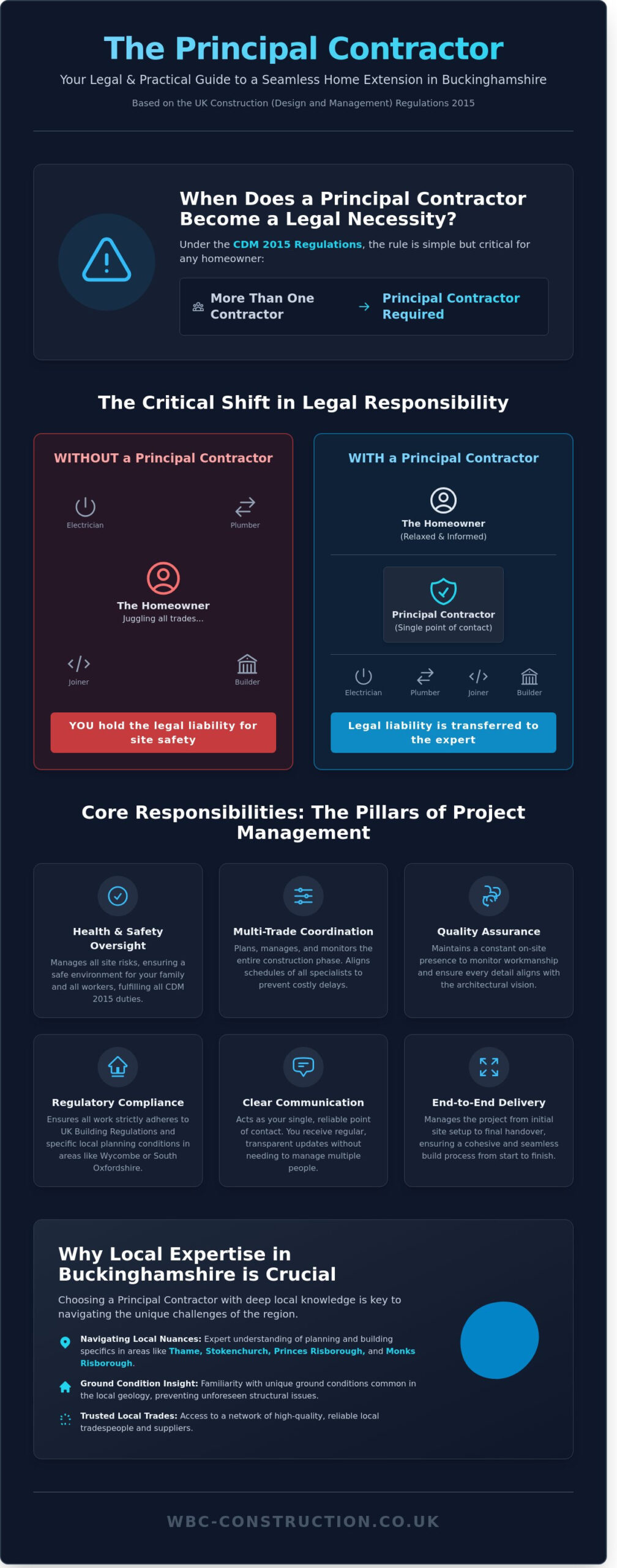
The Construction (Design and Management) Regulations 2015 are the primary laws governing site safety in the UK. These regulations apply to all building projects, including domestic renovations. The law requires the appointment of a Principal Contractor whenever more than one trade is present on-site at any time. This creates a single point of contact for site accountability, which is essential for maintaining order. This transition of duties is a formal process; it moves the legal responsibility for site safety from your shoulders to our experienced team. We manage the risks and coordinate the various contractors, ensuring that your home remains a safe and productive environment throughout the build.
Why Homeowners in Monks Risborough Need Professional Oversight
Projects in Monks Risborough or the wider Wycombe and South Oxfordshire districts often involve specific planning nuances that require expert navigation. A professional Principal Contractor understands these local requirements and ensures your project adheres to the highest standards of British craftsmanship. This meticulous management protects the long-term value of your property. Whether you initially searched for a “principle contractor” or a bespoke luxury builder, the requirement for professional management remains the same. Our team provides the following benefits to your Buckinghamshire home project:
- Seamless Coordination: We align the schedules of electricians, plumbers, and joiners to prevent delays.
- Regulatory Compliance: We ensure all work meets current UK Building Regulations and local planning conditions.
- Quality Assurance: We maintain a constant presence on-site to monitor the standard of work at every stage.
- Transparent Communication: You receive regular updates through a single, reliable point of contact.
Choosing a dedicated professional ensures that your vision is realised with integrity and precision. We focus on end-to-end delivery, meaning we are there from the initial site set-up until the final handover, providing a stress-free experience that prioritises your home’s structural and aesthetic perfection.
Why Every Multi-Trade Extension in South Oxfordshire Requires a Principal Contractor
The complexity of modern home improvements often surprises homeowners in South Oxfordshire. Under the Construction (Design and Management) Regulations 2015, the legal requirement to appoint a lead professional is triggered the moment more than one trade is involved. This isn’t a suggestion; it’s a statutory obligation designed to ensure safety and coordination on residential sites in areas like Ibstone or Chinnor.
A typical kitchen extension rarely involves just one person. It’s a sequence of specialised skills including groundworkers, bricklayers, plumbers, electricians, and joiners. Without a principle contractor to oversee this sequence, the project risks becoming a disjointed collection of tasks rather than a cohesive build. We ensure every transition between trades is seamless, maintaining the structural integrity and aesthetic finish of your home.
The “More Than One Contractor” Rule Explained
The term “contractor” applies to any individual or business involved in the build. Even a high-end bespoke garden room usually requires at least three distinct trades: a groundworks specialist for the foundations, a carpenter for the frame, and an electrician for the internal power. When these different professionals work on the same site, the law requires a principle contractor to manage the health and safety risks. This role is vital for synchronising the schedule, ensuring the plumber isn’t arriving before the floor is ready, or the tiler isn’t delayed by unfinished electrical first-fixing.
Domestic Client Duties vs. Professional Responsibilities
The Health and Safety Executive (HSE) recognises that domestic clients aren’t construction experts. Because of this, the legal duties of a homeowner automatically pass to the contractor in charge of the construction phase. This shift protects you from the technicalities of site management, provided you appoint a competent firm. Core Responsibilities: How a Principal Contractor Organises Your Site include creating a robust construction phase plan and ensuring unauthorised people don’t access the work zone.
Proceeding without a formal appointment carries heavy risks. You might find your site insurance is invalidated or face significant delays if a local authority inspector finds the site lacks proper safety documentation. We take this burden off your shoulders, providing professional indemnity and site-specific insurance that offers total peace of mind. Our meticulous approach ensures your project meets every legal standard while you focus on the vision for your new space. If you’re planning a project and want to ensure it’s managed correctly, you can view our project management approach to see how we handle every detail from start to finish.
Core Responsibilities: How a Principal Contractor Organises Your Site
The role of a principle contractor involves far more than simply supervising trades. It is a position of legal and professional accountability that ensures your home project moves from a technical drawing to a finished structure without compromise. Under the Construction (Design and Management) Regulations 2015, any project featuring more than one trade Requires a Principal Contractor to oversee the construction phase. We take this mandate as a foundation for our meticulous approach. Our team liaises directly with the Principal Designer to ensure every architectural nuance is achievable and safe. This partnership bridges the gap between creative intent and structural reality, providing a seamless transition from paper to post-hole.
We take full responsibility for planning, managing, and monitoring the entire construction phase. This includes implementing site-specific inductions for every craftsman who enters your property. These inductions aren’t mere formalities; they’re essential briefings that cover safety protocols, site boundaries, and the high standards of conduct we expect. By maintaining this level of discipline, we ensure the project remains on schedule while protecting the integrity of your home.
The Construction Phase Plan (CPP)
Before any physical work begins on your property, we draft a comprehensive Construction Phase Plan. This document outlines exactly how we’ll manage health and safety risks throughout the project duration. When working on a site in Thame or Stokenchurch, we tailor this plan to address specific local variables such as restricted access or proximity to public footpaths. The Construction Phase Plan is the living document that guides site safety and ensures every operative remains aligned with our high standards. It is a bespoke roadmap that we update as the project reaches different milestones, moving from initial groundworks to the final internal fit-out.
Coordinating Site Welfare and Public Safety
Maintaining a high-end construction site requires a focus on both worker welfare and public protection. We provide all necessary facilities for our team, ensuring they have a clean, dedicated space that doesn’t infringe on your private living areas. This professional separation is vital for your peace of mind during a long-term build. As your principle contractor, we also implement rigorous security measures to prevent unauthorised access, which is especially important in busy residential areas of Buckinghamshire.
Our logistics management is equally precise. We schedule skips and heavy deliveries to avoid peak traffic times, ensuring that narrow lanes remain clear for your neighbours and emergency services. This proactive coordination transforms a potentially disruptive build into a seamless, orderly experience. We focus on these details so you don’t have to, maintaining the harmony of your neighbourhood while we work to enhance your home.
Selecting a Principal Contractor for Your Project in Thame or Stokenchurch
Choosing the right team for a renovation in Thame or a structural build in Stokenchurch requires looking beyond the bottom line of a quote. You need a principle contractor who demonstrates verified Skills, Knowledge, and Experience (SKE). This framework is a legal pillar of the Construction (Design and Management) Regulations 2015, ensuring that the person leading your project is competent to manage both the physical build and the safety of everyone involved. A professional firm brings organisational capability that a “man with a van” cannot provide. While a solo trader might have individual craft skills, they often lack the administrative infrastructure to manage complex timelines or the rigorous safety standards required on modern Buckinghamshire sites.
Local expertise is equally vital. Buckinghamshire ground conditions vary significantly; for instance, projects in the Chilterns often encounter heavy clay or flint-heavy soil. A contractor familiar with these local variables will anticipate foundation requirements more accurately than an outsider. This foresight prevents the 15% to 20% budget overruns often seen when unforeseen ground issues arise mid-build. We focus on meticulous preparation to ensure your project remains on track and within the agreed parameters. When evaluating home improvement companies in Buckinghamshire, using a structured checklist to assess each firm’s project management framework and local expertise can help you avoid the costly delays that affect so many renovations.
Essential Questions to Ask Your Builder
Transparency is the foundation of a successful partnership. Before signing a contract, ask your builder how they manage health and safety for multiple trades on-site. A professional principle contractor should have a clear plan for coordinating plumbers, electricians, and carpenters simultaneously. You should also request a home improvement checklist tailored to your specific build to ensure no stage is overlooked. Finally, ask how they handle PC sums and construction quotes. Professional builders use these figures to provide honest, transparent estimates for items not yet selected, such as bespoke tiling or high-end fixtures, rather than hiding costs in vague descriptions. Understanding preliminaries meaning in construction quotes is equally important, as these essential site management costs typically represent 10% to 15% of your project’s value and ensure a seamless, well-organised build.
Red Flags to Avoid in the Buckinghamshire Trade
Identifying warning signs early protects your home and your finances. Be wary of any contractor who ignores CDM 2015 regulations or suggests they don’t apply to domestic projects. These laws are mandatory. Another major red flag is the “cash-in-hand” quote. While it might seem to offer a saving, it bypasses legal safety requirements and leaves you with no paper trail for insurance or warranties. A lack of written site plans is equally concerning. Without a documented schedule and safety plan, a project can quickly descend into chaos. Professionalism is defined by order, and a builder who cannot provide a clear roadmap is unlikely to deliver a high-quality finish.
Seamless Project Delivery: The WillsByrne Principal Contracting Approach
At WBC Construction, we’ve refined a “Concept to Completion” model that removes the traditional friction from complex building projects in Monks Risborough. By acting as your principle contractor, we take full responsibility for the site, from the initial set-up to the final handover. This holistic approach ensures that the meticulous craftsmanship our team is known for isn’t compromised by logistical gaps or mismanaged timelines. We blend time-honoured building techniques with modern project management systems to keep every stakeholder aligned from day one.
Managing luxury home extensions in Buckinghamshire requires more than just technical skill; it demands a single point of contact who understands the emotional and financial investment involved. You won’t have to juggle multiple trades or worry about scheduling conflicts between electricians and plasterers. We handle the complexity so you can focus on the transformation of your living space. This streamlined method provides a buffer against the typical stresses of construction, allowing for a more enjoyable renovation journey.
Meticulous Planning and Transparent Communication
Our expertise allows us to navigate the nuances of local planning authorities and building control regulations effectively. We establish clear milestones at the outset, providing you with regular digital updates and face-to-face briefings. This transparency ensures structural integrity is never a question, and high-end finishes are delivered exactly as specified. Industry data suggests that 95% of project delays stem from poor communication; it’s a statistic we actively combat through our structured reporting system. Our planning process includes:
- Detailed site assessments to identify potential structural hurdles early.
- Liaison with building control to ensure every stage meets UK regulations.
- Procurement of premium materials that match the architectural heritage of Buckinghamshire.
- Strict adherence to health and safety protocols to protect your property and our team.
Your Trusted Partner for South Oxfordshire and Bucks
Directors Wills and Byrne maintain a personal presence on every project we undertake. Our local reputation across Thame and Chinnor is built on a foundation of honesty and quiet excellence. We don’t believe in aggressive sales; we believe in results that stand the test of time. In our role as a principle contractor, we ensure that the values of WBC Construction are reflected in every brick laid and every joint finished.
If you’re ready to start your next build without the typical industry stress, let our team handle the complexities for you. We’re here to turn your vision into a structural reality with the precision and care your home deserves. Whether it’s a bespoke renovation or a large-scale extension, our commitment to quality remains the constant thread throughout the build.
Elevating Your Build with Meticulous Management
Successfully delivering a high-end renovation in Buckinghamshire requires more than just skilled labour; it demands rigorous site organisation and strict adherence to the CDM 2015 regulations. Appointing a dedicated principle contractor ensures that every phase of your South Oxfordshire extension is handled with professional authority and legal precision. This central role removes the logistical burden from your shoulders, providing a single point of accountability that maintains the integrity of your original vision. Whether you’re planning a complex build in Thame or a bespoke refurbishment in Stokenchurch, the right leadership is what secures long-term value.
At WBC Construction, we specialise in premium home transformations that are personally managed by our directors, Wills and Byrne. We’ll oversee every detail of your project to ensure a stress-free experience and a seamless handover. Our team blends traditional craftsmanship with modern efficiency, guaranteeing that your site remains safe, organised, and compliant at all times. We’re ready to bring our disciplined approach to your next structural project.
Discuss your bespoke project with our expert Principal Contractors today
Your home is your most significant investment, and we’re committed to protecting it through excellence and transparency.
Frequently Asked Questions
Do I legally need a Principal Contractor for a small kitchen extension?
You legally require a Principal Contractor if your project involves more than one trade contractor on site at any time. Under the CDM 2015 regulations, even a modest kitchen extension usually requires multiple specialists like plumbers, electricians, and joiners. If you don’t appoint one in writing, the builder in control of the construction phase automatically takes on these legal duties.
Can I act as my own Principal Contractor to save money?
You can act as your own Principal Contractor, but we advise against it unless you possess the technical health and safety expertise required by law. Domestic clients often find that managing the 2015 CDM regulations is complex and time-consuming. Most homeowners prefer to appoint a professional principle contractor to ensure all site safety standards and legal filings are handled with meticulous care.
What happens if my builder doesn’t mention CDM 2015 regulations?
Your builder is legally obligated to follow CDM 2015 regulations regardless of whether they mention them during the initial consultation. If a builder ignores these rules, the Health and Safety Executive (HSE) can issue a stop work notice, which halts your project immediately. We ensure all our projects comply with these 2015 standards from day one to provide you with a seamless, worry-free build.
Is a Principal Contractor the same as a Project Manager?
No, these are distinct roles with different legal liabilities and focuses. A Principal Contractor holds specific legal accountability for site health and safety, while a Project Manager focuses on budgets and timelines. While one firm often performs both roles, the principle contractor is a statutory requirement under UK law for multi-contractor sites. Our team provides this integrated service, combining high-end craftsmanship with rigorous safety management.
Does a garden room project require a Principal Contractor?
A garden room project requires a Principal Contractor if you employ more than one trade professional during the build. Even if the structure is prefabricated, the installation of foundations and electrical connections usually involves separate specialists. Under the Construction (Design and Management) Regulations 2015, these multi-trade projects must have a designated lead to coordinate safety and logistics on your property.
What are the penalties for not appointing a Principal Contractor?
The Health and Safety Executive (HSE) can impose unlimited fines or issue a Prohibition Notice to stop all work on your site if you don’t appoint a lead contractor. In 2023, the HSE prosecuted dozens of small-scale domestic projects for safety breaches, leading to significant financial losses for homeowners. Appointing a professional partner ensures you avoid these legal pitfalls and protects the integrity of your investment.
How much does hiring a Principal Contractor add to my project cost?
Hiring a professional lead typically adds between 5% and 15% to your total project budget, according to industry benchmarks from the Royal Institution of Chartered Surveyors (RICS). This fee covers the essential management of health and safety, site logistics, and subcontractor coordination. While it is an additional line item, it prevents the costly delays and legal risks that often arise in unmanaged home improvements.
What is the difference between a Principal Designer and a Principal Contractor?
The Principal Designer manages health and safety during the pre-construction phase, while the Principal Contractor takes over once work begins on site. Both roles are mandatory under the CDM 2015 regulations for projects with multiple contractors. We often act as both to provide a bespoke, end-to-end service that maintains a single point of accountability from your first sketch to the final handover.